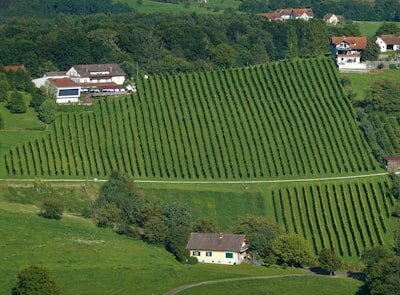
Deidesheimer Hohenmorgen
Deidesheimer Hohenmorgen is a small VDP.GROSSE LAGE Riesling vineyard set high on a sheltered plateau at the edge of Deidesheim in the…
South · 20
Site profile →
Riesling is the most soil-transparent grape in Germany. This hub groups the classified single vineyards (Einzellagen) by their dominant bedrock — blue and red slate, limestone, porphyry, loess, volcanic — and links each site to its region and the wines made from it.
Rich in calcium carbonate, limestone soils are alkaline and found in regions like parts of Pfalz and Württemberg. They typically produce well-structured Rieslings with good minerality and aging potential.
Deidesheimer Hohenmorgen is a small VDP.GROSSE LAGE Riesling vineyard set high on a sheltered plateau at the edge of Deidesheim in the…
Forster Ungeheuer is a VDP.GROSSE LAGE Riesling vineyard above Forst in the Pfalz, prized for a complex soil mosaic of weathered sandstone,…
Limestone Sandstone Volcanic Basalt
Dalsheimer Hubacker is a limestone Riesling vineyard in Flörsheim-Dalsheim, Rheinhessen. The VDP-classified Grosse Lage centers on the southeast-facing Oberer Hubacker parcel. An…
Deidesheimer Kalkofen is a small VDP.GROSSE LAGE Riesling vineyard set into the warm foothill belt of the Mittelhaardt, its limestone, loess loam…
Westhofener Kirchspiel is a VDP.GROSSE LAGE Riesling vineyard in Rheinhessen, occupying the upper reach of an east-facing amphitheatre where limestone-rich clay marl…
Ungeheuer is the vineyard name paired with the village Forst to form Forster Ungeheuer, a VDP.GROSSE LAGE Riesling site in the Pfalz.…
Limestone Sandstone Volcanic Basalt
A specific variant of slate found primarily in the middle Mosel region. Blue slate contains high levels of iron compounds that have been reduced (as opposed to oxidized), giving it a distinctive blue-gray color. Wines from blue slate soils often exhibit pronounced mineral notes and crisp acidity.
Graacher Himmelreich is a great Riesling vineyard of the Mosel, a VDP.GROSSE LAGE unfurling across a sheltered, south-to-southwest-facing slope beside Wehlener Sonnenuhr.…
Lieser Niederberg Helden is a precipitously steep, south-to-southwest-facing VDP.GROSSE LAGE Riesling vineyard rising above the Mosel village of Lieser. The VDP records…
Oberemmel Hütte is a small, high-elevation VDP.GROSSE LAGE Riesling vineyard, sharing its Saar side valley with the legendary Scharzhofberg. Earlier accounts misclassified…
Scharzhofberg is a cool, wind-swept Riesling site in a Saar side valley near Wiltingen (sharing the microclimate with neighboring Oberemmel Hütte), classified…
Scharzhofberger is the adjectival label form of Scharzhofberg, the VDP.GROSSE LAGE Riesling vineyard near Wiltingen in the Saar. This page addresses naming…
Wehlener Sonnenuhr is a precipitously steep, slate-soiled Riesling vineyard facing the Mosel village of Wehlen, classified by the VDP as a Grosse…
Found in regions like Pfalz and parts of Nahe, volcanic soils are rich in minerals and trace elements. They tend to produce powerful, mineral-driven Rieslings with good structure and aging potential.
Forster Ungeheuer is a VDP.GROSSE LAGE Riesling vineyard above Forst in the Pfalz, prized for a complex soil mosaic of weathered sandstone,…
Limestone Sandstone Volcanic Basalt
Hermannshöhle is the shortened name for Niederhäuser Hermannshöhle, a south-facing VDP.GROSSE LAGE Riesling vineyard set on a dramatic bend of the Nahe…
Porphyry Slate Volcanic Basalt
What is Niederhäuser Hermannshöhle? Niederhäuser Hermannshöhle is a VDP.Grosse Lage vineyard in Germany's Nahe region, and by most accounts, the finest site…
Porphyry Slate Volcanic Basalt
Ungeheuer is the vineyard name paired with the village Forst to form Forster Ungeheuer, a VDP.GROSSE LAGE Riesling site in the Pfalz.…
Limestone Sandstone Volcanic Basalt
Ürziger Würzgarten is a VDP.GROSSE LAGE Riesling vineyard on the Mosel, marked by a red, iron-rich mix of weathered slate and volcanic…
Common in the Pfalz region, sandstone soils warm quickly and provide good drainage. They typically produce Rieslings with pronounced fruit character and elegant structure.
Deidesheimer Hohenmorgen is a small VDP.GROSSE LAGE Riesling vineyard set high on a sheltered plateau at the edge of Deidesheim in the…
Forster Ungeheuer is a VDP.GROSSE LAGE Riesling vineyard above Forst in the Pfalz, prized for a complex soil mosaic of weathered sandstone,…
Limestone Sandstone Volcanic Basalt
Deidesheimer Kalkofen is a small VDP.GROSSE LAGE Riesling vineyard set into the warm foothill belt of the Mittelhaardt, its limestone, loess loam…
Ungeheuer is the vineyard name paired with the village Forst to form Forster Ungeheuer, a VDP.GROSSE LAGE Riesling site in the Pfalz.…
Limestone Sandstone Volcanic Basalt
Composed of thin layers of rock that split easily, slate soils are poor in nutrients and organic material but excellent for heat retention. In the steep Mosel valley, slate soils reflect heat onto the vines and provide good drainage, producing Rieslings with intense mineral character.
Hermannshöhle is the shortened name for Niederhäuser Hermannshöhle, a south-facing VDP.GROSSE LAGE Riesling vineyard set on a dramatic bend of the Nahe…
Porphyry Slate Volcanic Basalt
What is Niederhäuser Hermannshöhle? Niederhäuser Hermannshöhle is a VDP.Grosse Lage vineyard in Germany's Nahe region, and by most accounts, the finest site…
Porphyry Slate Volcanic Basalt
Rüdesheimer Berg Schlossberg is a single vineyard in Rüdesheim, in Germany's Rheingau region. It holds VDP.GROSSE LAGE status, the top rung of…
Volcanic rock formations found in the Nahe region, particularly around Bad Kreuznach. This igneous rock creates mineral-rich soils that impart distinctive characteristics to Riesling wines. The combination of volcanic minerals and excellent drainage properties produces wines with exceptional complexity and aging potential.
Hermannshöhle is the shortened name for Niederhäuser Hermannshöhle, a south-facing VDP.GROSSE LAGE Riesling vineyard set on a dramatic bend of the Nahe…
Porphyry Slate Volcanic Basalt
What is Niederhäuser Hermannshöhle? Niederhäuser Hermannshöhle is a VDP.Grosse Lage vineyard in Germany's Nahe region, and by most accounts, the finest site…
Porphyry Slate Volcanic Basalt
Soils with high clay content retain water and nutrients well but can have poor drainage. Found in various German wine regions, clay soils often produce fuller-bodied Rieslings with ripe fruit character.
Dalsheimer Hubacker is a limestone Riesling vineyard in Flörsheim-Dalsheim, Rheinhessen. The VDP-classified Grosse Lage centers on the southeast-facing Oberer Hubacker parcel. An…
Westhofener Kirchspiel is a VDP.GROSSE LAGE Riesling vineyard in Rheinhessen, occupying the upper reach of an east-facing amphitheatre where limestone-rich clay marl…
A metamorphic rock consisting primarily of quartz, found in some parts of the Nahe region. Quartzite soils produce Rieslings with racy acidity and pronounced mineral character.
Kiedrich Gräfenberg is an 11-hectare VDP.GROSSE LAGE Riesling vineyard, its precipitous slopes rising within the sheltered Kiedrich valley of the Rheingau. The…
Rüdesheimer Berg Schlossberg is a single vineyard in Rüdesheim, in Germany's Rheingau region. It holds VDP.GROSSE LAGE status, the top rung of…
Wind-blown silt deposits from the Ice Age, loess soils are fine-grained, fertile, and water-retentive. Common in regions like Rheinhessen and parts of Pfalz, these soils produce Rieslings with fuller body and ripe fruit flavors.
Kiedrich Gräfenberg is an 11-hectare VDP.GROSSE LAGE Riesling vineyard, its precipitous slopes rising within the sheltered Kiedrich valley of the Rheingau. The…
Found in areas like the Ürziger Würzgarten in the Mosel region, red slate contains oxidized iron compounds that give it a distinctive reddish color. Wines from these soils often have a spicy character along with their mineral notes, and can show more body than those from blue slate.
Ürziger Würzgarten is a VDP.GROSSE LAGE Riesling vineyard on the Mosel, marked by a red, iron-rich mix of weathered slate and volcanic…
Mosel Nahe Pfalz Rheingau Rheinhessen
Machine-readable: terroirs JSON · all data endpoints.