Kiedrich Gräfenberg
Vineyard Terroir & Geology
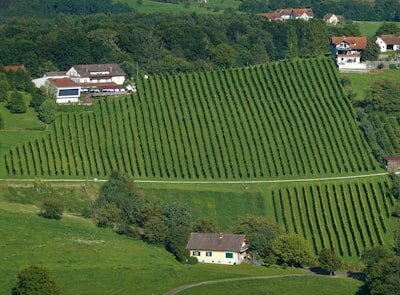
Kiedrich Gräfenberg is an 11-hectare VDP.GROSSE LAGE Riesling vineyard, its precipitous slopes rising within the sheltered Kiedrich valley of the Rheingau.
The site belongs, in reputation and history, to Weingut Robert Weil. Its southwest-facing slope, riven with stony phyllite and threaded with loess-loam, strikes a rare balance: daytime warmth, retained moisture, and cooling airflow descending from the Taunus.
Kiedrich Gräfenberg at a glance
| Region | Rheingau |
|---|---|
| Village | Kiedrich |
| VDP status | VDP.GROSSE LAGE |
| Classified area | About 10.7 ha |
| Aspect | Southwest |
| Elevation | About 230 m |
| Gradient | About 30–60% |
| Soil | Stony phyllite with loess-loam deposits |
| VDP grower | Robert Weil |
Slope, shelter and airflow
Gräfenberg climbs above the village at gradients reaching 60%, ranking it among the steepest sites in the VDP’s Rheingau directory.
The valley shelters the vines from harsher weather, while cool air draining down from the Taunus ventilates the canopy. This airflow can extend the hanging period well into autumn, giving the fruit time to develop complexity without losing acidity.
The southwest exposure captures long afternoon light, driving ripeness. But elevation and constant air movement keep this from being simply a “warm site” — restraint and precision remain part of the equation.
Phyllite and loess loam
The soil here runs medium to deep, stony and gritty, built on a foundation of phyllite. Pockets of loess loam add water-holding capacity where the rock alone would drain too fast.
This combination — deep rooting through fractured stone, moisture buffered by fine loam — shapes how the vines cope with both drought and deluge.
Robert Weil describes a house ideal built on mineral character, fine acidity, complexity and elegance. These remain producer goals and tasting descriptors rather than a claim that phyllite itself imparts a literal flavor to the glass.
Name, history and wine styles
The VDP traces the name to Graf, meaning count, citing the medieval designation “Mons Rhingravii” from the twelfth century.
Gräfenberg’s international reputation was cemented when Robert Weil supplied its 1893 Auslese to royal and imperial courts across Europe.
Today the vineyard yields dry Grosses Gewächs alongside Prädikat wines, including rare and sought-after sweet selections. This range makes Gräfenberg an ideal lens for studying how a single origin can express itself across radically different sweetness levels and concentrations.
How to explore Gräfenberg
Taste a Gräfenberg wine alongside Robert Weil’s Kiedricher village Riesling, or set it against bottlings from Turmberg and Klosterberg.
Holding the producer constant isolates the voice of the vineyard itself. For broader context, see the Rheingau producer guide.
Primary sources
Frequently asked questions
Is Kiedrich Gräfenberg a Grosse Lage?
Yes. The VDP classifies Gräfenberg, Kiedrich as VDP.GROSSE LAGE for Riesling.
Who produces Kiedrich Gräfenberg Riesling?
Robert Weil is the VDP grower listed for the classified site and is the estate most closely associated with it.
What soil is in Gräfenberg?
The VDP describes stony phyllite with deposits of loess loam that improve water retention.