Rüdesheimer Berg Schlossberg
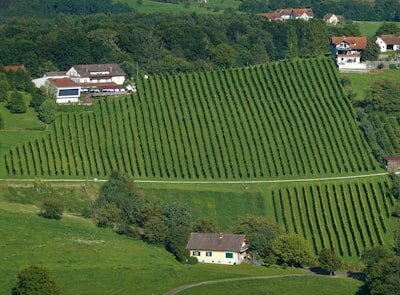
Vineyard Terroir & Geology
Rüdesheimer Berg Schlossberg is a single vineyard in Rüdesheim, in Germany’s Rheingau region. It holds VDP.GROSSE LAGE status, the top rung of the VDP’s vineyard classification—Germany’s answer to Grand Cru.
The site covers roughly 25 hectares of steep, terraced slope rising directly above the Rhein, planted almost exclusively to Riesling.
What sets this vineyard apart? It’s the steepest site in the Rheingau, with a gradient of 65 to 70 percent, quartzite and slate soils, and a river below that bounces additional light back onto the vines.
Those three elements combine to give the wines their signature power and taut structure.
For anyone drawn to vineyard character over famous labels, this is one of Germany’s most instructive sites. The wines are typically dry, with firm acidity, and the best examples improve for a decade or longer.
Rare sweet versions also exist—ranging from Auslese up to Trockenbeerenauslese—and they reveal an entirely different side of the site in the glass.
Key Takeaways
- Rüdesheimer Berg Schlossberg is a VDP.GROSSE LAGE site on the Rheingau’s steepest slope, directly below the ruins of Ehrenfels Castle.
- Taunus quartzite, phyllite slate, and pockets of loess shape dry Riesling marked by stone fruit, flinty edges, firm acidity, and serious cellar potential.
- The best way to understand Schlossberg is to taste it alongside Berg Rottland, Berg Roseneck, and Berg Kaisersteinfels from the same producer.
Location, Scale, And Historic Setting
The vineyard occupies the western end of the Rüdesheimer Berg, where the Rhein bends sharply north toward the Binger Loch. Its 25 hectares have been shaped by centuries of wall-building, hand labor, and later land reorganization.
Where the Site Sits Above the Rhein
Berg Schlossberg runs along a south to south-southwest facing slope directly above the river, at roughly 120 to 160 meters above sea level.
Traveling upriver from Assmannshausen toward Rüdesheim, Schlossberg is the first Einzellage you meet. The Taunus hills behind block cold northerly winds—a real advantage in this borderline climate.
The Rhein performs two jobs here: it moderates temperature swings, and its surface reflects extra light back onto the slope.
Ehrenfels Castle, the Binger Loch, and the Origin of the Name
The name traces to Zollburg Ehrenfels, the toll castle built around 1211 above the vineyard. Locals sometimes call the ruin the Ehrenfelser Schlossruine, and Burg Ehrenfels remains the site’s defining landmark.
Originally, Schlossberg referred only to the vines immediately surrounding the castle. Over time, the boundaries expanded to their present extent.
Just downstream lies the Binger Loch, a narrow rocky passage where the river cuts through resistant rock. That constriction in the valley is part of why this stretch is so precipitous.
Terraces, Vineyard Walls, and Flurbereinigung
Tall dry-stone walls hold sections of the slope in place. Without them, the thin soil would simply slide downhill.
Flurbereinigung—Germany’s process of consolidating and reshaping vineyard plots—eased access across many Rheingau sites. But on Berg Schlossberg, the steepest parcels resisted most of that reorganization, so the work is still done by hand, row by row.
Why the Vineyard Is So Extreme
Slope, rock, and river work in concert: more warmth, less water, thinner soil. That combination shapes both how ripe the grapes get and how much acidity the finished wines retain.
The 65–70% Gradient and South-Facing Exposure
A 65 to 70 percent gradient means the ground climbs about two-thirds of a meter for every meter walked forward. Stand on it for a minute and the need for hand labor becomes obvious.
The steep angle tilts the vines toward the sun, so every row captures more direct light than a flat vineyard at the same latitude—the practical reason Riesling ripens fully this far north.
Taunus Quartzite, Phyllite Slate, and Loess
The bedrock is Taunusquarzit, an ancient, hard quartzite, mixed with fine-grained phyllite slate. Pockets of loess and finer material gather where soil has accumulated.
Quartzite retains heat and drains quickly. Slate breaks down into thin, stony soil that holds a modest reserve of moisture deeper down.
| Soil element | Practical effect |
|---|---|
| Taunus quartzite | Stores daytime heat, drains sharply |
| Phyllite slate | Free drainage with modest water reserve |
| Loess pockets | Adds a little water-holding capacity |
Terroir here is a package deal, not a single variable. Soil influences vine behavior, but it doesn’t stamp one uniform flavor onto the wine.
Heat Storage, Rhine Reflection, and Frost Protection
Stones absorb warmth during the day and release it after sunset. The river throws back additional light and helps buffer against spring frosts.
The result is a longer, steadier ripening window. Sugar levels climb without acidity dropping away—the source of these wines’ characteristic tension.
Manual Work and Dry-Year Water Stress
Every task here—pruning, canopy management, harvest, hauling fruit downhill—is done by hand. Hand harvesting isn’t a marketing flourish; it’s the only method that works on this grade.
In dry summers, thin soil over solid rock can stress young vines for water. Older vines with deeper root systems generally cope better, which is a major reason vine age matters so much on this slope.
Riesling Style, Sweetness, And Aging Potential
Most Berg Schlossberg bottlings today are Trocken, structured, and built for the cellar. Sweet Prädikat wines still appear in favorable vintages and follow an entirely different timeline.
The Hallmarks of Dry Riesling From Schlossberg
Expect concentration over delicacy. These wines run medium to full-bodied for Riesling, with alcohol typically in the 12 to 13 percent range and a firm acid backbone.
Young bottles can feel tight and reticent. Give them air, or better yet, give them time.
Peach, Apricot, Flint, and Savory Mineral Notes
Schlossberg Rieslings are often described in terms of ripe peach and apricot, lemon and grapefruit zest, and a flinty, stony finish. With age, they turn savory, nutty, and faintly saline.
Treat these as common impressions rather than a guaranteed profile. Vintage, picking date, and cellar decisions all shift the flavors.
From Auslese to Trockenbeerenauslese
Prädikat designations describe grape ripeness at harvest, not a fixed sweetness scale. An Auslese from this vineyard can land anywhere from off-dry to lusciously sweet, depending on the producer.
Auslese, Beerenauslese, and Trockenbeerenauslese from Berg Schlossberg are rare, appearing only when botrytis and weather align. These dessert-scale wines carry enormous acidity, ensuring extraordinary longevity.
When to Drink and When to Cellar
- Dry GG or Erstes Gewächs: good at 3 to 5 years, often better still at 8 to 15
- Village or estate-level Rüdesheim Riesling: enjoyable within 2 to 6 years
- Auslese: 10 to 25 years, sometimes longer
- Beerenauslese and Trockenbeerenauslese: decades, with no urgency to open
If you can, buy two bottles. Open one now, cellar the other—you’ll learn more from that comparison than from any tasting note.
Schlossberg in the Context of Rüdesheimer Berg
The wider Rüdesheimer Berg spans roughly 95 hectares, divided among four top sites, or Spitzenlagen. Tasting them side by side is the fastest route to understanding what Schlossberg truly expresses.
Berg Rottland: Earlier Ripening and Harmonious Richness
Berg Rottland lies east of Schlossberg on slightly gentler slopes with deeper soil. Grapes here typically ripen earlier.
The resulting wines feel rounder and more immediately generous, usually approachable a year or two before Schlossberg.
Berg Roseneck: Soil Variation and Tension
Berg Roseneck sits above and between the other parcels, with greater variation in soil depth and stone content. That variability translates into tension in the glass.
Roseneck bottlings often occupy the middle ground between Rottland’s richness and Schlossberg’s grip—a useful reference point.
Berg Kaisersteinfels: Smaller-Scale, Stony Intensity
Berg Kaisersteinfels is the smallest of the four, perched on exceptionally stony ground at higher elevation. Yields run low, and the wines can be intensely stony and compact.
Bottles are scarce—treat one as a fortunate find rather than an everyday pour.
How to Compare Bottles by Producer and Site
Keep the producer constant and vary only the vineyard. That single habit removes most of the guesswork.
- Buy two or three wines from a single estate, same vintage, but from different Berg sites.
- Open them together at the same temperature.
- Pay attention to texture and finish, not just fruit.
Benchmark Producers and Buying Approach
Several estates farm plots here, and their styles diverge enough to teach a great deal. This isn’t a ranking—each producer simply offers a different reading of the same slope.
Georg Breuer and the Site’s Dry Grand Cru Benchmark
Weingut Georg Breuer, based in Rüdesheim, is the name most people reach for first. Their Berg Schlossberg draws from south and southwest-facing plots at varying elevations around the Ehrenfels ruin.
The style leans dry, structured, and slow to unfurl. Breuer labels its top wines by vineyard name rather than classification abbreviation, so keep that in mind while shopping.
Leitz, Kloster Eberbach, and August Kesseler
Leitz also farms in Rüdesheim and bottles a Berg Schlossberg, sometimes referencing Ehrenfels on the label. Kloster Eberbach, the historic Hessian state estate, offers a more classic, widely available take on Rheingau Grosses Gewächs.
Weingut August Kesseler, better known for Spätburgunder from Assmannshausen, brings a precise, lifted style to its Riesling—a reminder that Rüdesheim sits right between Pinot Noir country and Lorch, another Rheingau outlier.
Dr. Nägler and Weingut Künstler
Weingut Dr. Nägler has deep roots in Rüdesheim, and the estate holds valuable historical knowledge of how the Schlossberg boundary expanded from the vines around Burg Ehrenfels.
That context makes older bottles considerably easier to read.
Weingut Künstler crafts structured, age-worthy Berg Schlossberg Riesling. These wines reward patience—don’t rush to open them too soon.
How to Read Labels and Choose a First Bottle
Here’s what to check on the front and back label:
- The village and vineyard: Rüdesheim and Berg Schlossberg
- The style: Trocken for dry, or a Prädikat like Auslese
- Classification: VDP.GROSSE LAGE, Grosses Gewächs, or Erstes Gewächs
- Vintage, since Rheingau years swing considerably
New to the site? Start with a dry village-level Rüdesheim Riesling from a trusted producer, then grab their Berg Schlossberg from the same vintage for an instructive comparison.
Sekt and Pinot Noir from these estates are a different matter entirely—don’t judge the site by those.
One clarification: organic, biodynamic, or sustainability logos only indicate how the wine was farmed. They say nothing about vineyard classification. The VDP.GROSSE LAGE designation is about origin, not farming method.
Frequently Asked Questions
What makes this vineyard site one of the most prestigious in the Rheingau?
This site has the steepest slope in the region and faces south to south-southwest, directly above the Rhein. Centuries of winemaking took place here below Ehrenfels Castle. The VDP classifies it as GROSSE LAGE, its top tier, and it’s also eligible for the Rheingau’s Erstes Gewächs status.
Which grape varieties are primarily grown on its steep slopes?
Riesling, almost without exception. The wider Rüdesheimer Berg is over 90% Riesling, and Berg Schlossberg itself is essentially Riesling-only.
How does the quartzite soil influence the character of the wines?
Taunus quartzite drains rapidly and absorbs heat during the day, releasing it after dark. This steady warmth aids consistent ripening. Combined with phyllite slate, it creates thin, stony soils that restrain vine vigor and yield concentrated, firmly structured wines.
What styles of Riesling are typically produced from this site?
Dry Riesling dominates here, mostly bottled as Grosses Gewächs or Erstes Gewächs, marked by high acidity and a stony finish. In select years, producers also make Spätlese, Auslese, Beerenauslese, and Trockenbeerenauslese, though these sweeter wines remain rare.
Which producers are known for making wines from this vineyard?
Georg Breuer, Leitz, Kloster Eberbach, August Kesseler, Weingut Künstler, and Weingut Dr. Nägler all produce wine from this slope. Each brings a distinct style, so tasting several side by side reveals far more than settling on a single benchmark bottle.
How long can top wines from this site be aged?
Dry Grosses Gewächs bottlings usually hit their stride three to five years after the vintage and often continue improving for ten to fifteen years. Auslese can age two decades or longer, while Beerenauslese and Trockenbeerenauslese sometimes outlast even that—though storage conditions matter just as much as the vintage itself.