Why German Riesling Is Sweet or Dry: Fermentation, Residual Sugar & Acidity

German Riesling can taste dry, off-dry or lusciously sweet, and the reason comes down to one variable: how much grape sugar survives fermentation. Ripeness supplies the raw material. Yeast converts sugar into alcohol. The winemaker’s decisions in the cellar determine whether that conversion runs to near-completion or stops early, leaving natural sweetness behind.
Acidity reshapes how that sugar is perceived. Riesling carries such vivid natural acidity that a wine with real residual sugar can still taste bright and cut rather than heavy. This page walks through the mechanism itself. For the legal label thresholds, see our German Riesling sweetness guide.
The sweet-or-dry process in five steps

- Grapes arrive with natural sugar and acidity shaped by variety, site, weather, and ripeness at harvest.
- The grapes are pressed, and the juice begins alcoholic fermentation.
- Yeast converts fermentable sugar into alcohol and carbon dioxide.
- If fermentation runs its full course, the finished wine can be dry. If it is interrupted, or cannot consume all available sugar, residual sugar remains.
- Acidity, alcohol, temperature, and aroma all shape how sweet the resulting wine tastes on the palate.
What is residual sugar?
Residual sugar is the sugar left in a wine once alcoholic fermentation stops. It’s measured in grams per liter (g/L). The number is precise, but perceived sweetness is never determined by that figure alone.
For still German wine, regulated terms like Trocken, Halbtrocken, Lieblich, and Süß are built on residual-sugar limits, with acidity-linked allowances raising the ceiling for the upper Trocken and Halbtrocken ranges.
How a Riesling becomes dry

During fermentation, yeast consumes grape sugars and produces alcohol. When fermentation proceeds until almost no fermentable sugar remains, the wine can qualify as dry, depending on its final residual sugar and acidity balance.
DWI describes dry wine as almost or completely fermented. For a shopper standing at a shelf, Trocken is the clearest regulated signal that a still wine is dry.
How a Riesling keeps natural sweetness

A winemaker can preserve sweetness by halting fermentation before all grape sugar converts. DWI notes that modern cellar temperature control is often the tool used to interrupt fermentation, leaving natural, unfermented grape sugar in the wine.
Cooling alone isn’t the whole story. The producer must also manage yeast and microbial activity so fermentation doesn’t restart later in the bottle. Racking, filtration, and sulfur management often play a role, depending on the wine and vintage.
Why starting grape ripeness matters

A riper grape generally starts fermentation with more sugar than a less-ripe one. That affects potential alcohol, and the amount of sugar available to remain if fermentation is stopped short of dryness.
But starting ripeness does not dictate final sweetness. A ripe must can ferment fully dry, while another wine of similar ripeness retains substantial residual sugar. This is exactly why Prädikat and finished-wine sweetness must be read as two separate things.
Prädikat does not decide final sweetness
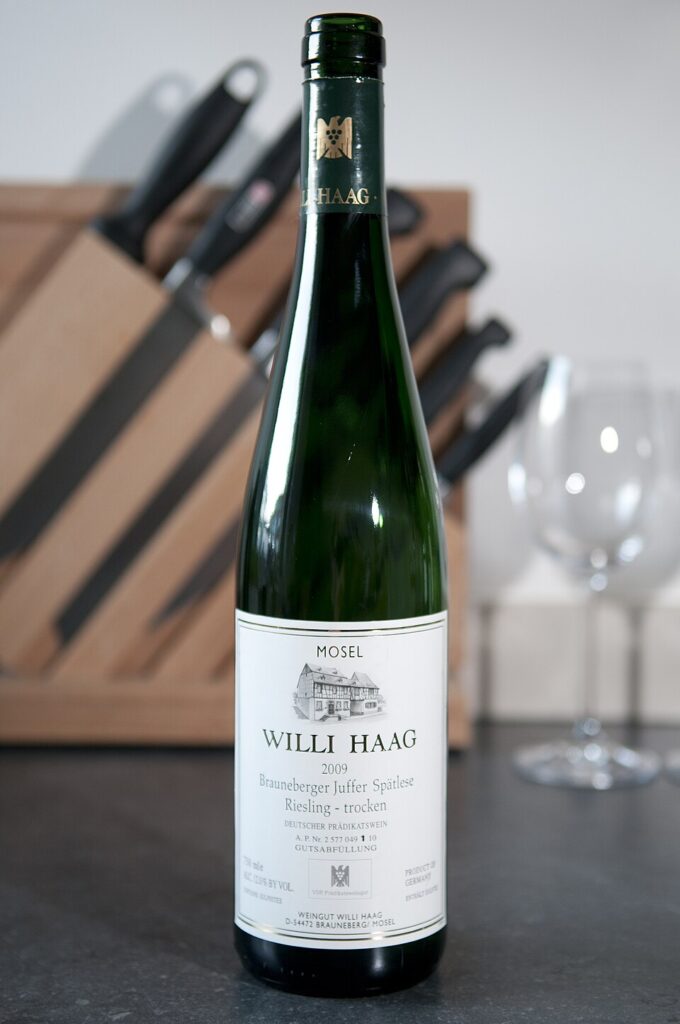
Kabinett, Spätlese, Auslese, Beerenauslese, Eiswein, and Trockenbeerenauslese are legal Prädikat categories. They describe grape condition, ripeness, and production requirements at harvest, not a fixed residual-sugar band in the finished wine.
A Spätlese Trocken makes the point plainly: the wine meets Spätlese ripeness requirements yet finishes bone-dry. See our German Riesling label guide for the full classification system.
Why noble-sweet wines can retain so much sugar

In noble-sweet styles, grape sugar concentrates dramatically before fermentation even begins. Botrytis dehydrates suitable berries, while Eiswein concentrates must when naturally frozen grapes are pressed under strict legal conditions.
DWI notes that such concentrated must is genuinely difficult for yeast to ferment through completely. The result: noble-sweet wines can carry very high natural residual sugar while staying remarkably low in alcohol.
What botrytis changes

Botrytis cinerea, when it develops as noble rot under the right conditions, perforates grape skins and draws water out of the berries. This concentrates sugar, acidity, and other grape constituents, and transforms aroma and texture entirely.
Botrytis matters for styles like Beerenauslese and Trockenbeerenauslese, but it isn’t a requirement for every sweet Riesling. Fruity Kabinett or Spätlese hold onto sweetness without any noble rot involved.
Why acidity makes sweet Riesling taste fresher

Sugar and acidity are perceived together, not separately. Higher acidity can make the same residual-sugar level taste noticeably less sweet, which is exactly why German law allows the upper Trocken and Halbtrocken limits to rise when acidity is sufficiently high.
There’s no universal “perfect sugar-to-acid ratio” that defines great Riesling. Balance also depends on alcohol, extract, serving temperature, food pairing, and individual sensitivity to sweetness.
Does alcohol percentage reveal sweetness?
Alcohol percentage reflects how much sugar converted during fermentation, so it offers useful context. A traditional low-alcohol fruity Mosel Riesling often retains far more sugar than a fully fermented dry wine.
But ABV alone is not a reliable sweetness test. Starting ripeness and cellar decisions vary too much. Read the label terms and technical data first; treat alcohol as a supporting clue, not proof.
Can sweetness be added back after fermentation?

German winemaking has historically included techniques using unfermented or concentrated grape must for sweetness adjustment where legally permitted. The important buying point: final residual sugar is not evidence of one single production method.
If a producer’s specific method matters to you, consult the estate’s technical sheet rather than assuming every off-dry German Riesling was made by arrested fermentation or by blending in a sweet reserve.
What temperature does to perceived sweetness

Serving temperature genuinely changes perception. A cooler wine can taste tighter and less aromatically expressive; as it warms, fruit and sweetness become more apparent. None of this changes the actual residual sugar in the glass.
For practical guidance rather than chemistry myths, see our German Riesling serving-temperature guide.
Dry, off-dry and sweet are not quality rankings
A dry Riesling is not inherently more serious than a sweet one, and residual sugar is no indicator of lesser craftsmanship. The right comparison is whether a wine’s sweetness, acidity, concentration, and intended style all work together.
The same producer can craft an exceptional dry GG, a fruity Kabinett, and a noble-sweet Auslese in the same cellar — each answers a different stylistic question.
A practical way to compare the mechanism yourself

- Choose a clearly labeled Trocken Riesling.
- Choose a fruity or off-dry Riesling from the same region, ideally with published technical data.
- Serve both at similar temperatures.
- Compare sweetness, acidity, alcohol, and body before reading any tasting notes.
- Then check the residual sugar and acidity figures, if available, and see how the numbers match what you perceived.
For an easy regional comparison, try wines from Mosel or Nahe, where producers routinely make both dry and fruity styles from the same Einzellage.
Common misconceptions

- “Kabinett is a sweetness level.” It’s a Prädikat, not a fixed residual-sugar category.
- “Riper grapes always make sweeter wine.” Fermentation can convert that extra sugar entirely into alcohol and still finish bone-dry.
- “Low alcohol proves a wine is sweet.” It’s a clue, not proof.
- “Sweet Riesling is made by adding table sugar.” Residual sweetness typically comes from natural grape sugar left after fermentation; specific cellar methods vary by producer.
- “There is one ideal sugar-to-acid ratio.” Balance can’t be reduced to a universal formula.
- “Sweet means low quality.” Sweetness is style, not a quality score.
Which page should you read next?

| Your question | Best guide |
|---|---|
| What are the legal sweetness thresholds? | German Riesling Sweetness Guide |
| Is the bottle in my hand sweet? | Is Riesling Sweet or Dry? |
| What does Feinherb mean? | Feinherb Meaning |
| How do I read Prädikat and VDP terms? | German Riesling Label Guide |
| How is Riesling made more broadly? | How German Riesling Is Made |
Frequently Asked Questions

Are German Rieslings dry or sweet?
German Rieslings can be completely dry, intensely sweet, or anywhere in between. The sweetness depends on how the winemaker handles fermentation. If they allow the yeast to consume all the natural grape sugar, the wine will be dry (Trocken). If they stop fermentation early, natural grape sugar remains in the wine, creating an off-dry or sweet style.
Why do people think all Riesling is sweet?
Historically, many mass-market German Rieslings exported to international markets in the late 20th century were made in a cheap, sweet style (like Liebfraumilch). This created a lasting misconception. Today, the majority of Riesling produced and consumed in Germany is actually dry (Trocken), though the country still produces some of the world’s finest sweet wines.
Is Kabinett Riesling dry or sweet?
A Kabinett Riesling can be either dry or sweet. Kabinett is a Prädikat (a classification of grape ripeness at harvest), not a sweetness level. A Kabinett wine made from early-picked grapes can be fully fermented into a dry wine (Kabinett Trocken), or fermentation can be stopped early to leave residual sugar for a fruity, off-dry style.
Does a low alcohol percentage mean the Riesling is sweet?
Often, yes, but it is not a guarantee. Because yeast converts grape sugar into alcohol, a wine that stops fermenting early will have both more leftover sugar (sweetness) and lower alcohol (often 7% to 9% ABV). A fully fermented dry Riesling typically has a higher alcohol content (11% to 13% ABV). However, always check the label for terms like Trocken or Halbtrocken rather than relying on ABV alone.
Primary sources
Germany Rieslings Editorial Team
German Wine Editorial ReferenceResearched, structured, and fact-checked against official Deutsches Weininstitut (DWI) documentation, German Federal Wine Law (Weingesetz), and VDP.Die Prädikatsweingüter standards.