Ürziger Würzgarten
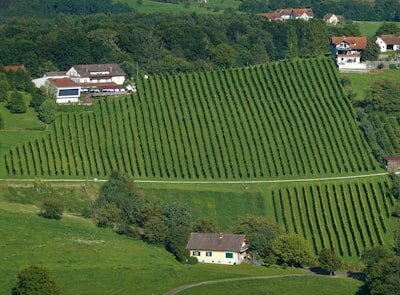
Vineyard Terroir & Geology
Ürziger Würzgarten is a VDP.GROSSE LAGE Riesling vineyard on the Mosel, marked by a red, iron-rich mix of weathered slate and volcanic rock. The site rises as a steep south- to southeast-facing amphitheatre opposite Erden, climbing from roughly 110 to 220 metres with gradients reaching 80%.
An earlier version of this page called it an Erste Lage. That was wrong. The VDP classifies Würzgarten, Ürzig as VDP.GROSSE LAGE. The registered vineyard covers about 53 hectares, though the VDP’s mapped classification reflects its own producer-based boundaries — not a universal legal ranking.
Ürziger Würzgarten at a glance
| Region | Mosel, by Ürzig |
|---|---|
| VDP status | VDP.GROSSE LAGE |
| Primary grape | Riesling |
| Aspect | South to southeast |
| Elevation | About 110–220 m |
| Gradient | About 20–80% |
| Soil | Red weathered slate and volcanic material, coloured by iron oxides |
| Name | “Spice garden,” linked to medieval herb gardens and spiced wine |
A red amphitheatre above the Mosel
Würzgarten curves around the hillside in a natural amphitheatre. Its red surface sets it apart from the grey and blue slate slopes typical of the Middle Mosel.
Individual parcels differ in height, steepness and exposure. The vineyard name alone doesn’t guarantee a uniform growing environment across the site.
The steepest sections are still worked with Riesling trained on individual stakes — a traditional system suited to tight, irregular slopes, but one that demands intensive manual labour. Aspect and slope angle boost sun exposure, while the river moderates temperature and adds reflected light.
Red slate, volcanic rock and iron
The VDP describes the ground as red volcanic soil and slate. Weathered red slate debris carries a high proportion of rock, and iron oxides give the surface its vivid hue.
This composition shapes drainage, heat retention and how roots move through the hillside. It does not literally transfer “spice” or minerals into the finished wine.
Würzgarten is often cited as proof that terroir means more than bedrock. Elevation, airflow, water availability, vine age, canopy management and harvest timing all interact with geology. A cool vintage and a warm vintage from the same parcel can taste quite different before cellar decisions even enter the picture.
Where the name “Spice Garden” comes from
The name is historical, not a tasting-note invention. The VDP links Würzgarten to the medieval practice of making Würzweine — wines flavoured with herbs. Communities kept herb gardens for this purpose, and a thirteenth-century document records a fief winegrower named Godefridus Th. Wurzegard. A demonstration herb garden now stands within the slope.
What Ürziger Würzgarten Riesling tastes like
Producers and tasters often describe Würzgarten Riesling with ripe citrus, stone fruit, red fruit, herbs and warm spice. These are recurring sensory associations, not guarantees.
Styles range from dry bottlings through Kabinett, Spätlese and Auslese, with richer noble-sweet examples possible in suitable years.
The site can deliver substantial fruit and texture while retaining the acidity that defines Mosel Riesling. Kabinett tends to favour lift and delicacy; later-picked wines show greater concentration. Dry Grosses Gewächs bottlings, made under VDP rules, aim for a dry expression rooted firmly in the classified site.
Producers and comparison bottles
The VDP directory lists Dr. Loosen and Reichsgraf von Kesselstatt as member estates working this classified site. Other producers bottle Ürziger Würzgarten under German wine law, so the VDP list is not a full ownership register. Keep “VDP growers shown on the map” distinct from “all vineyard owners.”
For context, compare Würzgarten with Wehlener Sonnenuhr, associated with grey-blue Devonian slate and a different river position. Tasting one producer or vintage across both sites isolates real differences far better than treating red-slate and blue-slate wines as fixed flavour categories.
How to read a bottle label
“Ürziger” names the village; “Würzgarten” names the vineyard. Check separately for trocken, feinherb or a Prädikat term — none of these should be assumed from the vineyard name alone.
Alcohol level can offer a clue: a low-alcohol Prädikat bottling often retains more residual sugar. Still, the label and technical sheet remain more reliable than any rule of thumb.
A practical comparison and food pairing
To learn the site, taste a dry bottle alongside a residual-sugar Kabinett or Spätlese from the same vintage. This shows how sweetness, alcohol and harvest timing shift texture without erasing the site’s identity.
A second comparison with Erdener Treppchen or Wehlener Sonnenuhr places the red slope in useful local context.
Dry Würzgarten Riesling pairs well with roast poultry, freshwater fish and herb-forward dishes. Off-dry examples suit aromatic or moderately spicy food, where acidity and residual sugar balance heat. Sweeter Auslese works with fruit desserts or blue cheese — but let the actual bottle guide the pairing, not the vineyard name alone.
Visitors can view the red slope from Ürzig and the opposite riverbank. Stay on public or marked paths: the vineyard is active farmland, and loose rock underfoot can be hazardous. The steepness makes far more sense in person than on any map.
Primary sources
Frequently asked questions
Is Ürziger Würzgarten a Grosse Lage?
Yes. The VDP classifies Würzgarten, Ürzig as VDP.GROSSE LAGE.
Why is the soil red?
The weathered slate and volcanic material contain iron oxides, which give the vineyard surface its distinctive red colour.
What does Ürziger Würzgarten mean?
It means the spice garden of Ürzig. The name is linked to medieval herb gardens used when communities made spiced wines.
Is Ürziger Würzgarten Riesling always sweet?
No. The vineyard produces dry wines as well as Kabinett, Spätlese, Auslese and, in suitable years, noble-sweet styles.