Scharzhofberg
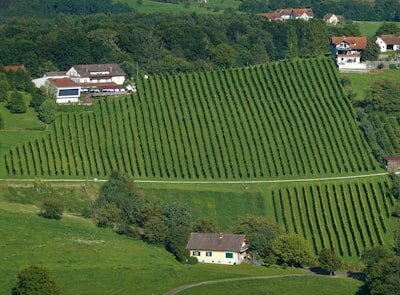
Vineyard Terroir & Geology
Scharzhofberg is a cool, wind-swept Riesling site in a Saar side valley near Wiltingen (sharing the microclimate with neighboring Oberemmel Hütte), classified as VDP.GROSSE LAGE. Its roughly 28-hectare slope climbs to some 300 metres, faces south-southeast to south-southwest, and is built on highly weathered grey and red Devonian slate laced with fine earth.
Scharzhofberg is closely tied to the name Egon Müller, but it is not a monopole. The VDP directory lists several member growers, and Bischöfliche Weingüter Trier documents ownership of 6.3 hectares within the site. The old claim of exclusive Müller ownership was inaccurate and has been corrected.
Scharzhofberg at a glance
| Region | Saar sector of the Mosel wine region |
|---|---|
| Nearby village | Wiltingen |
| VDP status | VDP.GROSSE LAGE |
| Grape | Riesling |
| Area | About 28 ha overall; figures vary slightly by mapped boundary |
| Elevation | Roughly 216–300 m per the VDP profile |
| Gradient | About 20–60% |
| Soil | Highly weathered grey and red Devonian slate, greywacke and fine earth |
| Ownership | Multiple estates; not a monopole |
A Saar vineyard set back from the river
Scharzhofberg lies east of Wiltingen in a side valley, not directly above the Saar itself. Its broad, table-like form and wooded crest set it apart from the narrow, river-hugging terraces most people picture when they think of the Mosel. Height and exposure let cool air and wind move freely through the vines.
The VDP describes a cool microclimate marked by sharp temperature swings. A depression in the mid-slope holds warmth, while the wooded ridge above helps sustain water supply. Together these can lengthen ripening and preserve acidity — but vintage conditions still decide the outcome. Reputation alone guarantees nothing in a difficult year.
Weathered slate and slope structure
The rock fraction here is high, and the slate is unusually decomposed. Grey and reddish slate, greywacke, clay and silt appear across the slope, with iron inclusions accounting for the reddish tones in some material. Lower sections carry more fine earth and hold water differently than the leaner, rockier parcels above.
These differences matter: Scharzhofberg is not one uniform block. Parcel position, vine age and grower decisions all create real variation. Soil governs water, warmth and rooting conditions — but it is not a fixed recipe for a single aroma profile.
Who owns Scharzhofberg?
The current VDP vineyard listing names Egon Müller–Scharzhof, Reichsgraf von Kesselstatt, Van Volxem and Stiftungsweingut Vereinigte Hospitien as member growers working the classified site. Bischöfliche Weingüter Trier separately confirms that 6.3 of the vineyard’s 28.1 hectares belong to it. Bottlings from Weingut von Hövel further confirm that ownership extends well beyond a single estate.
Egon Müller remains the vineyard’s most internationally celebrated producer, and its rare auction wines have made Scharzhofberg a global benchmark. But fame and sole ownership are two different claims. A monopole means one estate controls the entire vineyard; Scharzhofberg plainly does not meet that definition.
Monastic history and the Scharzhof
The vineyard’s history runs through ecclesiastical ownership. The VDP traces a donation to the monastery of St. Marien back to around the year 700. Bischöfliche Weingüter records later medieval vineyard holdings and a press house, followed by secularisation and sale around 1800. The old and new sections of the Scharzhof subsequently passed into separate hands — the root of today’s divided ownership.
Riesling styles and aging
Scharzhofberg yields dry, off-dry and sweet Riesling across the full Prädikat scale — Kabinett, Spätlese, Auslese, and rare Beerenauslese or Trockenbeerenauslese. Common tasting notes point to delicacy, citrus, herbs, slate-like minerality and searing acidity. These traits shift with parcel, producer, ripeness and vintage.
The site’s cool conditions can support an extended growing season. In favorable years, selective picking and botrytis development make concentrated, noble-sweet wines possible. Bischöfliche Weingüter’s 2025 report, for instance, describes leaving botrytised fruit on the vine until mid-October for Beerenauslese and Trockenbeerenauslese. That is a vintage-specific result, not an annual certainty.
How to buy and compare Scharzhofberg Riesling
Start with producer, vintage and style rather than price alone. A Kabinett from one parcel and cellar can differ enormously from a dry Grosses Gewächs or a sweet Auslese. Where possible, taste two growers from the same vintage side by side to see how farming and cellar choices interact with a shared origin.
Labels may read either “Scharzhofberg” or the adjectival “Scharzhofberger,” often without a village name attached. Our separate Scharzhofberger label guide explains that convention. For broader regional context, see the Mosel slate and terroir guide.
Auction prices and everyday buying
Record auction results tied to rare Egon Müller bottlings are real, but they are a poor guide to general pricing. They concern tiny quantities, special selections, mature provenance or unique formats — not the everyday Scharzhofberg bottle. Explore the vineyard through releases from several growers and across sweetness levels, rather than treating a headline auction price as typical retail cost.
When judging age-worthiness, distinguish a delicate Kabinett from a concentrated Auslese or TBA. Both can live for decades, but they follow different arcs. Stable storage is essential, and provenance matters increasingly with older bottles. Serve young examples cool, then let the glass warm slowly so aroma and texture can unfold.
Primary sources
- VDP Vineyard.Online: Scharzhofberger
- Bischöfliche Weingüter Trier: Scharzhofberger profile and ownership
- Bischöfliche Weingüter Trier: Scharzhof history
Frequently asked questions
Is Scharzhofberg owned only by Egon Müller?
u003cpu003eNo. Egon Müller is its most famous producer, but the vineyard is divided among several owners and is not a monopole.u003c/pu003e
Who else owns or farms Scharzhofberg?
u003cpu003eCurrent sources identify estates including Bischöfliche Weingüter Trier, Reichsgraf von Kesselstatt, Van Volxem, Vereinigte Hospitien and von Hövel, in addition to Egon Müller.u003c/pu003e
Is Scharzhofberg a Grosse Lage?
u003cpu003eYes. The VDP classifies Scharzhofberger, Wiltingen as VDP.GROSSE LAGE.u003c/pu003e
Why can the label say only Scharzhofberger?
u003cpu003eThe vineyard is famous enough that labels traditionally use Scharzhofberg or Scharzhofberger without adding the village name.u003c/pu003e