Graacher Himmelreich
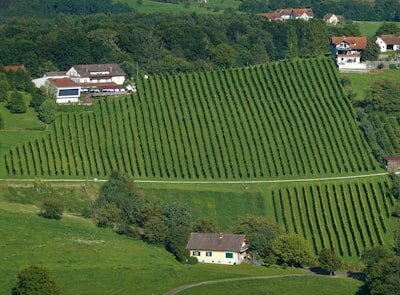
Vineyard Terroir & Geology
Graacher Himmelreich is a great Riesling vineyard of the Mosel, a VDP.GROSSE LAGE unfurling across a sheltered, south-to-southwest-facing slope beside Wehlener Sonnenuhr.
Blue and grey Devonian slate, a water-bearing hillside, direct river exposure and pockets of traditional stake-trained vines set this site apart from its neighbours. Yet as ever in the Mosel, producer and vintage remain the final word on what lands in the glass.
Graacher Himmelreich at a glance
| Region | Mosel |
|---|---|
| Village | Graach |
| VDP status | VDP.GROSSE LAGE |
| Classified area | About 66 ha |
| Aspect | South to southwest |
| Elevation | About 110–325 m |
| Gradient | About 45–75% |
| Soil | Blue and grey slate |
| Grape | Riesling |
Position beside Wehlener Sonnenuhr
Himmelreich runs seamlessly along the Mosel’s curve near Wehlener Sonnenuhr. The slope tilts toward a river that throws light back onto the vines, while the valley walls shelter it from harsher winds.
Its considerable elevation range — from riverside to nearly 325 metres — means lower, middle and upper parcels ripen under quite different conditions. This is no single, uniform terroir.
Some vines still stand on individual stakes, a labour-intensive relic of traditional steep-slope viticulture. Gradients of 45–75% demand that virtually all work here be done by hand.
Blue-grey slate and water veins
The VDP’s official profile describes blue and grey slate that warms quickly under sun, threaded with water veins that cross the slope and feed the vines through the growing season.
Dr. Loosen points to deeper seams of blue slate within the site. Markus Molitor instead highlights firmer slate mixed with clay, sheltered by the forest crowning the hill above. Both accounts hold true — a vineyard of this size inevitably contains real variation.
Soil here governs drainage and water supply. It is not a guarantee of any fixed set of aromas in the finished wine.
Wine style and producers
Himmelreich Riesling appears Trocken, Feinherb and in fully sweet Prädikat styles, from Kabinett through Auslese. Expect citrus peel, dried herbs, orchard fruit and a taut spine of acidity running through every rendition.
The current VDP directory lists Dr. Loosen, Joh. Jos. Prüm, S. A. Prüm, Willi Schaefer, Schloss Lieser, Wegeler and Van Volxem among its growers.
Better than chasing a fixed “Himmelreich flavour”: taste it against Graacher Domprobst from the same producer, or against Wehlener Sonnenuhr in the same vintage. The comparison reveals far more than any tasting note alone.
Name and label
Himmelreich literally means “kingdom of heaven,” though the VDP suggests a Celtic root closer to “small hill.” On a bottle, “Graacher” names the village and “Himmelreich” the Einzellage — sweetness level must always be read separately, whether stated outright or implied by Prädikat.
Primary sources
- VDP Vineyard.Online: Himmelreich, Graach
- Dr. Loosen: Graacher Himmelreich
- Markus Molitor vineyard profiles
Frequently asked questions
Is Graacher Himmelreich a Grosse Lage?
Yes. The VDP classifies Himmelreich, Graach as VDP.GROSSE LAGE.
What soil is in Graacher Himmelreich?
The official VDP profile describes blue and grey slate, with water veins supplying the slope.
Is Graacher Himmelreich Riesling always sweet?
No. Producers make dry, off-dry and sweet wines from the vineyard.