Kirchspiel
Vineyard Terroir & Geology
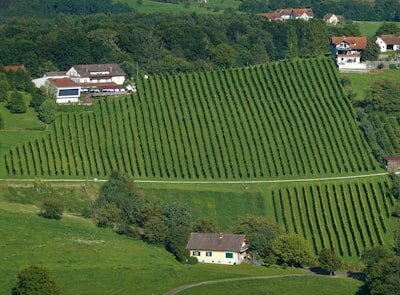
Westhofener Kirchspiel is a VDP.GROSSE LAGE Riesling vineyard in Rheinhessen, occupying the upper reach of an east-facing amphitheatre where limestone-rich clay marl defines the wine’s structure.
This sheltered semicircle catches morning sun at roughly 150 metres elevation. Its classified core—some 16.6 hectares—is farmed by three of Rheinhessen’s most exacting estates: K. F. Groebe, Keller, and Wittmann.
Kirchspiel at a glance
| Region | Rheinhessen |
|---|---|
| Village | Westhofen |
| VDP status | VDP.GROSSE LAGE |
| Classified area | About 16.57 ha |
| Aspect | East, southeast and south |
| Elevation | About 150 m |
| Gradient | About 20–35% |
| Soil | Clay marl with limestone fragments and limestone bedrock |
| VDP growers | K. F. Groebe, Keller and Wittmann |
An east-opening amphitheatre
Kirchspiel traces the curve of a basin that opens toward the Rhine. The VDP-classified upper section faces mainly south and southeast, catching the earliest light of the day.
A protective ridge shields the vines from cooling winds, concentrating warmth within the bowl.
This curved topography explains why the vineyard’s aspect spans east, southeast, and south rather than a single compass point. Within the arc, a parcel’s exact position shapes its character.
Limestone, clay marl and vine growth
The soil layers clay marl over abundant limestone fragments and weathered limestone loam, resting on solid limestone bedrock.
Clay and marl retain moisture through dry spells. The limestone beneath governs drainage and pushes roots deep in search of water and minerals. This equilibrium proves invaluable during Rheinhessen’s increasingly arid summers.
Tasters often describe the resulting Rieslings in terms of citrus, yellow orchard fruit, herbal top notes, and a firm, chalky backbone. These remain sensory shorthand—useful descriptors, not proof that limestone itself carries flavour into the glass.
History and producers
The VDP traces the name to a 1348 document referencing “Kyrsbühel.” By 1834, chronicler Johann Philipp Bronner had already ranked Kirchspiel alongside Aulerde among Westhofen’s finest sites. Riesling has remained its defining grape ever since.
K. F. Groebe, Keller, and Wittmann now hold the VDP growers’ rights to Kirchspiel. Tasting their wines side by side reveals how cellar philosophy—whether Trocken precision or a touch more residual sweetness—can reshape the voice of a single shared terroir.
What to compare
Within Westhofen, set Kirchspiel against Morstein or Aulerde. For a broader Rheinhessen comparison, pour it alongside Hubacker. All four sites share limestone influence, yet slope shape, sun exposure, and soil depth pull each wine in its own direction.
Primary source
Frequently asked questions
Is Westhofener Kirchspiel a Grosse Lage?
Yes. The VDP classifies Kirchspiel, Westhofen as VDP.GROSSE LAGE for Riesling.
What soil is in Kirchspiel?
The VDP describes clay marl with limestone fragments, weathered limestone loam and limestone bedrock.
Which producers make Kirchspiel Riesling?
The current VDP directory lists K. F. Groebe, Keller and Wittmann.