Hubacker
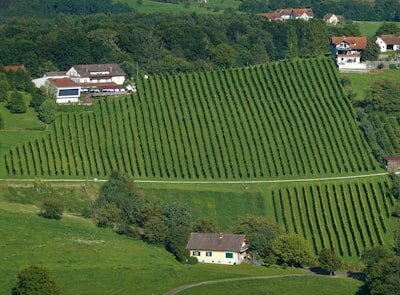
Vineyard Terroir & Geology
Dalsheimer Hubacker is a limestone Riesling vineyard in Flörsheim-Dalsheim, Rheinhessen. The VDP-classified Grosse Lage centers on the southeast-facing Oberer Hubacker parcel.
An earlier version of this page incorrectly named Hubacker as the source of Keller‘s G-Max. G-Max is not sold under Hubacker as its declared vineyard, so that claim has been removed. Hubacker carries its own weight and identity — it needs no borrowed reputation.
Hubacker at a glance
| Region | Rheinhessen |
|---|---|
| Village | Flörsheim-Dalsheim |
| VDP status | VDP.GROSSE LAGE (Oberer Hubacker core) |
| Classified area | About 3.65 ha |
| Aspect | Southeast |
| Elevation | About 170–200 m |
| Gradient | About 25–30% |
| Soil | Limestone rock with loess, clay marl and sandy loam |
Where Hubacker sits
The classified parcel lies in the rain shadow of the Donnersberg — a pocket of limited rainfall and reliable wind shelter.
The southeast-facing slope catches early morning sun, while its elevated position keeps air moving through the canopy. In dry seasons, this combination puts real pressure on water supply and rewards vines with deep, established root systems.
The distinction between the registered Einzellage and the VDP core matters. A bottle labeled Dalsheimer Hubacker is governed by German wine law, while the VDP map identifies the specific parcel its member producer treats as Grosse Lage.
Area figures can differ between the two systems without either source being wrong — they’re simply answering different questions.
Limestone, marl and water balance
The VDP describes limestone bedrock alongside stony loess, clay marl, sandy loam and weakly stony clay. This is not a simple “pure limestone” site.
The mixture governs drainage and how much water reaches the vine, while the hard rock beneath can restrict and redirect root growth.
Limestone is often linked in tasting language to tension or chalkiness, but geology doesn’t dictate flavor on its own. Vintage, canopy management, yields, picking time and fermentation choices all shape what ultimately reaches the glass.
Name, history and producer
The VDP traces the name to a 1490 Dalsheim record mentioning five “Huffen.” A Hufe, or Hube, was a historic unit of land measurement.
The classified site is closely associated with Weingut Keller, listed in the current VDP directory as the member grower working the vineyard.
Hubacker Riesling typically appears as a dry, structured wine built to express site origin. For a useful comparison, taste it alongside Westhofener Kirchspiel. Both are Rheinhessen limestone sites, yet their aspect, topography and soil composition diverge.
How to read the bottle
Look for producer, vintage, Dalsheimer Hubacker and any VDP marks. “GG” signals a dry wine made under VDP Grosses Gewächs rules from a Grosse Lage site.
It does not mean every wine from the larger registered vineyard automatically qualifies as GG.
Primary source
Frequently asked questions
Is Hubacker a Grosse Lage?
The VDP classifies the Oberer Hubacker core in Flörsheim-Dalsheim as VDP.GROSSE LAGE.
Does Keller G-Max come from Hubacker?
Keller does not declare G-Max with Hubacker as its vineyard, so the two should not be presented as the same wine or site.
What soil does Hubacker have?
The VDP describes limestone rock with loess, clay marl, sandy loam and stony clay components.