Forster Ungeheuer
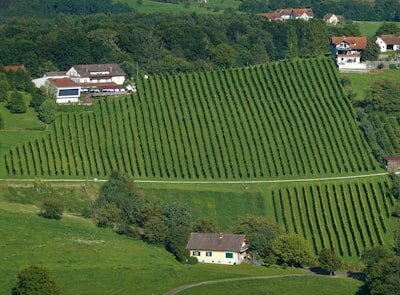
Vineyard Terroir & Geology
Forster Ungeheuer is a VDP.GROSSE LAGE Riesling vineyard above Forst in the Pfalz, prized for a complex soil mosaic of weathered sandstone, clay, limestone rubble and pockets of basalt. The classified slope climbs from roughly 125 to 180 metres, faces east to southeast, and ranges from nearly flat ground to a 30% gradient.
The vineyard belongs to the celebrated run of sites along the Mittelhaardt, where the Haardt hills shield the vines from western rain and wind while the Rhine plain opens eastward to the morning sun. Ungeheuer is large enough to contain real parcel variation — no single soil description or tasting note applies evenly across every bottle.
Forster Ungeheuer at a glance
| Region | Pfalz, above Forst |
|---|---|
| VDP status | VDP.GROSSE LAGE |
| Classified grape | Riesling |
| Area | About 35 ha in the VDP profile |
| Elevation | About 125–180 m |
| Aspect | East to southeast |
| Gradient | About 0–30% |
| Soil | Weathered Buntsandstein, sandy clay and loam, limestone rubble, with local basalt |
Location and climate on the Mittelhaardt
Ungeheuer occupies the mid-slope above Forst as the land rises toward the Haardt. Morning sun strikes the east-facing rows, while the hills blunt the wet Atlantic weather. This rain-shadow effect is one reason the Pfalz runs warmer and drier than the steep river valleys farther north.
That doesn’t make water irrelevant. The VDP notes clay and limestone components with genuine water-holding capacity. In dry vintages, the balance between stony drainage and finer, moisture-retaining material becomes decisive. Site performance reflects this physical mix as much as vine age, root depth and farming practice.
A more complex soil than “basalt vineyard”
Ungeheuer is sometimes summarized as volcanic or basalt soil, but the official VDP description is more nuanced. Basalt appears only in small sections. Weathered Buntsandstein, sandy clay, loam, limestone and limestone rubble are the major components across the site.
That distinction matters. Neighbouring Forst vineyards such as Pechstein have their own geological identities, and flattening them all into “volcanic Pfalz” erases useful differences. Soil affects heat retention, drainage, water supply and root growth — it doesn’t mechanically stamp a basalt flavour onto the wine.
Where the Ungeheuer name comes from
“Ungeheuer” translates to monster or enormous in modern German, but the vineyard name traces to a person, not a myth. The VDP links it to Johann Adam Ungeheuer, an official recorded in Deidesheim in 1699. The site was recognised as outstanding in the Bavarian land classification of 1828.
A famous line attributed to Otto von Bismarck plays on the double meaning: the Ungeheuer tasted “ungeheuer” good. The anecdote burnished the vineyard’s reputation, but the documented origin in a family name remains the more useful explanation.
What Forster Ungeheuer Riesling is like
Most leading examples are dry, often bottled as Grosses Gewächs by VDP estates. Common descriptors include yellow fruit, citrus, herbs, spice and a firm, sometimes smoky or stony structure. Treat these as recurring tasting impressions, not guaranteed properties of the ground itself.
Compared with the delicate, low-alcohol styles of the Mosel, Ungeheuer typically shows more body and breadth — though vintage and producer can shift that balance considerably. Good bottles age well for years, trading primary fruit for wax, dried herbs and savoury depth. Storage conditions matter far more than any universal drinking-window claim.
Producers working in the site
The current VDP profile lists Von Winning, Geheimer Rat Dr. von Bassermann-Jordan, Reichsrat von Buhl, Acham-Magin, Dr. Bürklin-Wolf and Georg Mosbacher. Comparing two estates in the same vintage is the clearest way to see how cellar choices interact with a shared vineyard identity.
For a local comparison, taste Ungeheuer beside Forster Pechstein or Kirchenstück. For a different Pfalz soil profile entirely, try Deidesheimer Hohenmorgen or Deidesheimer Kalkofen.
How to interpret VDP.GROSSE LAGE and GG
VDP.GROSSE LAGE identifies the association’s highest-ranked vineyard sites. VDP.GROSSES GEWÄCHS, usually shortened to GG, designates a dry wine from a Grosse Lage that meets the association’s production rules. The vineyard and the wine are related concepts — not interchangeable terms.
The VDP classification is influential but private. German wine law governs protected origin and labeling more broadly. A grower outside the VDP may still farm an exceptional parcel without ever using the association’s Grosse Lage or GG designations.
Vintage, service and food
Warm, dry seasons tend to emphasize ripeness and breadth, while cooler years foreground acidity and herbal detail. These are tendencies, not verdicts — harvest timing and yield can shift the outcome considerably. Young GG often benefits from decanting and a serving temperature around 10–12 °C. A broad glass gives a concentrated dry Riesling more room to open than a narrow flute.
At the table, dry Ungeheuer pairs well with richer fish, roast poultry, pork, and dishes built on mushrooms or browned butter. Its acidity refreshes, while the site’s typical body meets savoury flavours halfway. Don’t choose by vineyard name alone — check alcohol, vintage and producer notes to gauge how powerful the actual bottle will be.
Primary source
VDP Vineyard.Online: Ungeheuer, Forst
Frequently asked questions
Is Forster Ungeheuer a Grosse Lage?
Yes. The VDP classifies Ungeheuer, Forst as VDP.GROSSE LAGE for Riesling.
Is Forster Ungeheuer a volcanic vineyard?
Only partly. The VDP describes small amounts of basalt, but weathered sandstone, clay, loam and limestone rubble are major soil components.
Why is the vineyard called Ungeheuer?
The name is linked to Johann Adam Ungeheuer, an official recorded in 1699, rather than simply meaning that the vineyard is a monster.
Which producers make Forster Ungeheuer GG?
VDP growers include Von Winning, Bassermann-Jordan, Reichsrat von Buhl, Acham-Magin, Dr. Bürklin-Wolf and Georg Mosbacher.