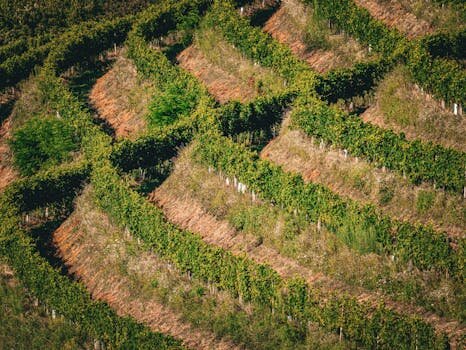
German Riesling Guide: Styles, Labels, Regions and Buying

German Riesling is not one taste or sweetness level: it can be dry, off-dry, fruit-sweet, noble-sweet or sparkling, with style shaped by origin, vintage and producer choices. Germany had 24,233 hectares of Riesling in 2024—about 45% of the world’s Riesling area, according to the German Wine Institute (DWI).
German Riesling in 60 seconds
- Grape: late-ripening, aromatic and naturally high in acidity, with German records dating to 1435.
- Styles: still or sparkling; trocken, off-dry, fruit-sweet and noble-sweet.
- Labels: origin and sweetness terms tell you more than assuming a Prädikat equals sweetness.
- Core regions: Mosel, Rheingau, Nahe, Pfalz and Rheinhessen are essential starting points, not a complete quality ranking.
- Buying rule: choose producer, place, style and vintage together — never a national score or a “mineral soil” claim alone.
What German Riesling tastes like
DWI describes typical Riesling with peach or apple aromas and marked acidity. Depending on ripeness, age and winemaking, a bottle may also suggest citrus, flowers, herbs, stone fruit, spice, wax or honey.
Bottle-aged Riesling can develop complex tertiary aromas — think petrol, dried fruit, toast. These are possibilities, not a checklist guaranteed by a region or soil type.
“Mineral” is a useful tasting word, but it shouldn’t be mistaken for proof that dissolved slate or limestone has moved directly into the wine. Soil affects drainage, water supply, root environment and heat balance; climate, vine and grower decisions interact with all of it.
Our Mosel terroir guide explains that relationship without resorting to “liquid geology” claims.
Dry, off-dry and sweet: the terms that matter
| Label cue | What it tells you | What it does not tell you |
|---|---|---|
| trocken | The wine meets the legal definition of dry | Body, fruit ripeness, quality or ageability |
| halbtrocken | The wine meets a regulated off-dry category | Exactly how sweet it will taste against its acidity |
| feinherb | Common producer language for a balanced off-dry style | One nationally fixed residual-sugar range |
| Kabinett / Spätlese / Auslese | A Prädikat tied to harvest must weight and other rules | Guaranteed finished sweetness; some are made dry |
| Beerenauslese / TBA / Eiswein | Rare, concentrated Prädikat categories with strict harvest conditions | That every region or vintage can produce them |
| Sekt | Sparkling wine | Production method or origin, unless stated separately |
Alcohol level offers another clue. A low-ABV Riesling may retain meaningful residual sugar because fermentation stopped before all grape sugar converted to alcohol, while a fully fermented dry wine typically shows more alcohol. Treat this as a clue, not a substitute for the label or technical sheet.
See the full German Riesling sweetness guide.
German wine law and Prädikat
The legal framework includes German wine, Landwein with a protected geographical indication, and Qualitätswein or Prädikatswein from protected origins. The six Prädikats are Kabinett, Spätlese, Auslese, Beerenauslese, Eiswein and Trockenbeerenauslese.
Minimum must weights, measured in Oechsle, vary by grape and region. Prädikatswein may not be enriched to raise alcohol; Qualitätswein may be enriched within legal limits.
Germany is also moving toward a more origin-led system. The amended law entered into force in 2021 and becomes binding from the 2026 vintage after a transition period.
Within protected-origin wines, the hierarchy runs from a wine-growing area through Region and village wine to single-vineyard, or Einzellage, wine. New national rules also govern the terms Erstes Gewächs and Grosses Gewächs. Labels from 2025 and earlier may still reflect the prior rules, so vintage matters when decoding terminology.
VDP classification: related, but not German wine law
The VDP is a private association of estates with its own four-tier origin classification:
- VDP.Gutswein: estate-level origin.
- VDP.Ortswein: wine associated with a village’s vineyards.
- VDP.Erste Lage: classified first-class vineyard origin.
- VDP.Grosse Lage: the association’s highest vineyard classification.
A dry wine from a VDP.Grosse Lage is called VDP.Grosses Gewächs, or GG. Grosse Lage names the site classification; GG names the dry wine made from it. Fruit-sweet wines from those same sites instead carry traditional Prädikat terms.
Non-VDP producers can make outstanding wines, and the legal Grosses Gewächs rules arriving with the new framework should not be silently substituted for VDP rules. Read the focused Grosse Lage vs Grosses Gewächs guide.
Five regions to learn first
| Region | Useful starting point | Do not assume |
|---|---|---|
| Mosel | Steep river valleys; Riesling ranging from dry to fruit-sweet, often with vivid acidity, largely on Devonian slate | Every wine is low-alcohol, sweet, or grown on blue slate |
| Rheingau | High Riesling share; dry and Prädikat traditions along the Rhine | Every vineyard faces due south or makes a powerful dry style |
| Nahe | Compact region with exceptional geological and site diversity | “Volcanic” describes the whole region or one fixed flavor |
| Pfalz | Large, relatively warm and dry region; major dry Riesling country | North and south, or forest-edge and exposed sites, behave alike |
| Rheinhessen | Germany’s largest wine region; important limestone (Muschelkalk) and Rhine-facing sites | Wonnegau, Roter Hang and broad regional blends are interchangeable |
Germany has 13 protected wine-growing regions. Riesling also matters in the Mittelrhein, Württemberg, Baden and elsewhere, though it is not the leading grape everywhere. Use the 13-region comparison for the full map.
How to buy a German Riesling
- Choose sweetness first. Look for trocken, halbtrocken, feinherb or a producer’s residual-sugar information.
- Choose scale of origin. Region, village and vineyard labels offer progressively narrower place information — not automatic proof of quality.
- Identify the system. An eagle logo and VDP terms signal association rules; ordinary legal categories apply more broadly.
- Check the vintage. Weather affects regions and sites differently. Use the 2010–2025 vintage guide as context, not a bottle score.
- Read the AP number. Qualitätswein and Prädikatswein carry an official approval number that identifies the tested bottling.
- Buy one before six. Taste the exact bottling before committing to a case or a long aging plan.
Food, serving and storage
Dry Riesling’s acidity and citrus-like freshness suit seafood, pork, poultry, vegetables or creamy sauces. A lower-alcohol off-dry style handles chile heat and sweet-savory sauces more comfortably.
Noble-sweet wines are concentrated enough for small pours with blue cheese, fruit desserts, or on their own. Match the sweetness and weight of the wine to the dish — not the nationality of either.
DWI recommends roughly 9–11°C for young, light white wines and 11–13°C for mature, fuller whites. Start cool and let the wine warm in the glass.
For storage, use a cool, dark, odor-free and vibration-free place with stable temperature. Natural-cork bottles intended for long storage are normally kept on their side.
Do not assign every Kabinett, GG or Auslese a fixed lifespan. The Riesling aging guide explains how style, acidity, sugar, concentration, closure and provenance change the answer.
Buy mature bottles to drink, unless you have professional advice on authentication, storage, insurance and resale. Rarity alone does not guarantee an investment return.
Climate change and recent vintages
Warming can reduce historic ripening risk in northern winegrowing, but it also advances vine development and can increase exposure to spring frost, heat, drought, sunburn, intense rain and compressed harvests.
DWI’s 2024 and 2025 reports show why “warmer means better” fails as a rule: local frost, rainfall, grape health, picking date and yield differed sharply by region.
The 2025 national crop was the smallest since 2010, with strong quality reports but large regional differences in volume. That does not make every bottle scarce, ageworthy or more valuable. Use the exact regional vintage guide and producer evidence before buying.
Sources
- German Wine Institute: Riesling history, plantings and style
- German Wine Institute: Prädikat categories
- German Wine Institute: amended wine law and 2026 transition
- German Wine Institute: official quality testing and AP numbers
- VDP: association classification and GG rules
- German Wine Institute: 2025 regional vintage report
Frequently asked questions
Is German Riesling always sweet?
u003cpu003eNo. German Riesling ranges from trocken (dry) through off-dry and fruit-sweet styles to rare noble-sweet wines, and it is also made as sparkling Sekt. Prädikat terms such as Kabinett and Spätlese describe harvest criteria, not a guaranteed finished sweetness.u003c/pu003e
What does trocken mean on a German Riesling label?
u003cpu003eTrocken is the regulated term for dry wine. It is more useful for predicting sweetness than the Prädikat alone. Feinherb is commonly used for a balanced off-dry impression but is not defined by one national legal residual-sugar limit.u003c/pu003e
What is the difference between Grosse Lage and Grosses Gewächs?
u003cpu003eIn the VDP system, Grosse Lage is the highest vineyard classification. Grosses Gewächs, commonly shown as GG, is the dry wine from a VDP.Grosse Lage. VDP is a private growers’ association, not the whole of German wine law.u003c/pu003e
Which German region makes the best Riesling?
u003cpu003eThere is no objective winner. Mosel, Rheingau, Nahe, Pfalz and Rheinhessen are major reference points, while other German regions also make Riesling. The best choice depends on the producer, site, vintage and style you want.u003c/pu003e
How long can German Riesling age?
u003cpu003eSome concentrated dry, fruit-sweet and noble-sweet Rieslings can develop for many years, while simple wines are intended for earlier drinking. Sweetness, acidity, concentration, closure and storage all matter, so no single regional window is reliable.u003c/pu003e
What should a beginner look for on the label?
u003cpu003eStart with producer, region, village or vineyard, grape, trocken or another sweetness cue, Prädikat if present, alcohol by volume, vintage and the AP number. If sweetness is unclear, check the producer’s technical sheet or ask the retailer.u003c/pu003e
Related reading
– Best German Riesling Under $20 in the USA (2026 Buying Guide)
– German Riesling History: From Medieval Vines to Modern Revival
Germany Rieslings Editorial Team
German Wine Editorial ReferenceResearched, structured, and fact-checked against official Deutsches Weininstitut (DWI) documentation, German Federal Wine Law (Weingesetz), and VDP.Die Prädikatsweingüter standards.