German Riesling History: From Medieval Vines to Modern Revival
On March 13, 1435, a cellar account from Rüsselsheim recorded the purchase of six Riesling vines for 22 solidi. That single line in Count John IV of Katzenelnbogen’s household ledger remains the earliest known written mention of the grape by name. It begins a story that runs through monastery cellars, nineteenth-century auction rooms, supermarket shelves, and the dry bottles you find in wine shops today.
Once you know how German Riesling history unfolded, the confusing parts of a German label stop being confusing: Prädikat words describe grape ripeness at harvest, trocken describes how the finished wine tastes, and VDP terms describe vineyard rank. Those three ideas came from three different centuries, which is why they can sit side by side on the same bottle without meaning the same thing.
The stakes are practical. Wines from the Rhine and Mosel once sold for more than first-growth Bordeaux, then collapsed into a cheap-and-sweet stereotype before climbing back. Every turn left a mark on the wines you can buy right now.
Key Takeaways
- Riesling was first recorded by name in 1435, and monasteries along the Rhine and Mosel built the steep-slope vineyard culture that still defines the grape.
- Nineteenth-century Rhine and Mosel wines outpriced top Bordeaux, while postwar Liebfraumilch brands created the sweetness stereotype that many buyers still carry.
- Modern German Riesling is largely dry, site-focused, and organized by origin, so ripeness terms, sweetness terms, and vineyard classifications must each be read separately.
Origins Along the Rhine and Mosel
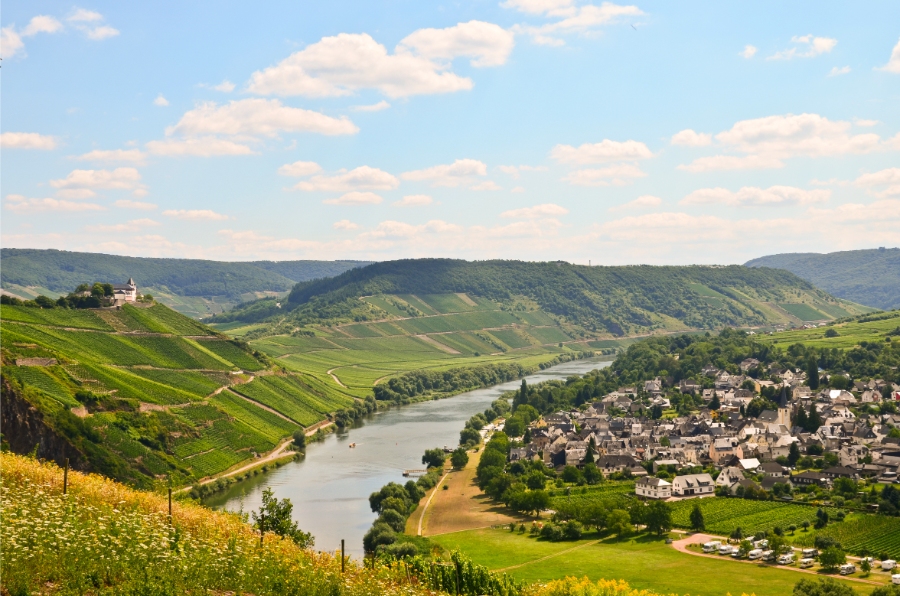
German Riesling began where the vine barely ripens: on the steep, sun-facing slopes of river valleys in western Germany. The Rhine and the Mosel act like heat traps, bouncing light off the water onto slate and stone. That geography helps explain why Riesling took hold here rather than on flat farmland.
Two thousand years of vine growing, one dated cellar record, and a parentage puzzle solved by DNA all shape how people understand the grape today.
Roman Vineyards, Trier, and the River Valleys
Roman legions planted vines along the Mosel and Rhine to supply Trier, their major northern city, roughly two thousand years ago. Wine production here dates to around 100 B.C. in the broader region, and Roman growers already recognized sites such as Piesporter Goldtröpfchen on the Mosel.
Those early plantings set a pattern. The best land was never the valley floor. It was the steep bank, angled toward the sun, where a cool climate could still deliver ripe fruit.
After Rome withdrew, the Church kept viticulture alive. Christianity’s spread in the eighth century pushed vineyard work outward. Monasteries became centers of record-keeping and vineyard know-how in German Riesling regions that still matter commercially.
The 1435 Record in Rüsselsheim
The 1435 entry from Rüsselsheim, near the Rheingau, names “Riesling” in a purchase log kept for Count John IV of Katzenelnbogen. A man named Klaus Kleinfisch supplied six vines, and the household wrote down the price.
That document matters because it is dated and specific. Other claimed early plantings, including a thirteenth-century Wachau reference in Austria, lack that kind of paperwork.
The record also tells you something about status. Someone thought this variety was worth buying deliberately, by name, and noting in the accounts of a noble household.
Where the Riesling Grape Came From
Riesling, sometimes called Rheinriesling, is a natural cross with Gouais Blanc as one parent. Gouais Blanc was an old, widely planted variety that fathered a surprising number of European grapes. The other side of the parentage traces back to wild vines and a Traminer relative from the Rhine area.
This makes Riesling a genuinely local product of German viticulture. It didn’t arrive from somewhere warmer and get adapted.
Its late ripening and high natural acidity, which would be a liability farther south, became the grape’s advantage in cool river valleys where the growing season stretches into late autumn.
Monasteries, Estates, and Late-Harvest Innovation

Monastic orders turned scattered vineyards into an organized system, and one Rheingau estate gave the world the vocabulary for late-harvest wine. Benedictine and Cistercian communities kept written harvest records, terraced difficult slopes, and separated wine by parcel. Those practices laid the groundwork for the ripeness-based classifications used later.
The 1775 Spätlese story and the arrival of noble rot changed what German wine could be. They added an entire sweet category to a country already known for tense, high-acid whites.
How Benedictines and Cistercians Shaped Vineyard Culture
Cistercian monks at Kloster Eberbach in the Rheingau, founded in the twelfth century, ran what became Germany’s largest and most active monastery. They walled off parcels, tracked which sections ripened best, and built terraces that made near-vertical slate slopes workable.
That parcel-by-parcel thinking is the ancestor of today’s single-vineyard labeling. Monks practiced quality control by geography centuries before anyone wrote a wine law.
Their labor also solved the steep-slope problem. Hand-worked terraces on gradients too sharp for animals or machinery remain standard practice in the Mosel today.
Schloss Johannisberg, Kloster Eberbach, and the 1775 Spätlese Story
Vines have grown at Schloss Johannisberg since 817. In 1720, Prince-Abbot Konstantin von Buttlar replanted the entire slope to Riesling, making it the first estate in the world devoted exclusively to the grape.
The famous 1775 story goes like this: pickers needed formal permission from the abbot before harvest, but a messenger carrying that permission arrived badly late. By then, the grapes had shriveled and mold had touched them. The monks pressed them anyway and produced a rich, sweet wine.
Treat it as a well-documented legend rather than a laboratory result. The estate’s own records support the delayed harvest, and whether or not every detail is exact, Spätlese (“late harvest”) entered the German wine vocabulary during that period.
Botrytis and the Rise of Noble-Sweet Wines
Botrytis cinerea, known as noble rot, shrivels ripe grapes and concentrates sugar, acid, and flavor. In damp autumn mornings followed by dry afternoons along the Rhine and Mosel, it arrives reliably enough to build a wine style around.
That gave German growers a ladder of ripeness levels, later written into law: Kabinett, Spätlese, Auslese, Beerenauslese, Trockenbeerenauslese (TBA), and Eiswein from frozen grapes. These Prädikatswein categories depend on must weight, the sugar concentration in the juice at harvest.
Here is the point buyers still get wrong. Must weight measures ripeness, not the sweetness of the wine in your glass. A high natural acidity level lets a producer ferment that sugar out completely. That’s why Prädikat terms are not a sweetness ladder.
From Nineteenth-Century Prestige to Postwar Decline
Rhine and Mosel Rieslings were once the most expensive white wines in the world, listed above the finest red Bordeaux on New York restaurant wine lists. Two world wars, vineyard disease, and a postwar rush toward volume erased that position within roughly a century.
The mass-market brands that followed did more to shape American assumptions about German wine than any monastery or auction ever did.
Why Great Rhine and Mosel Wines Commanded Record Prices
By the 1850s, Riesling’s reputation had exploded across export markets. Top Rhine wines sold for more than Bordeaux and Champagne, and menus from expensive nineteenth-century New York restaurants priced the best Rhine whites above the “best” red Bordeaux.
Scarcity drove part of this. Great vintages in a cool climate were rare, while aristocratic and monastic estates held the finest slopes. The wines also aged for decades.
The English-speaking world called them “hock” and “Moselle,” and they appeared at royal tables. That era explains why older collectors still treat mature Riesling as a serious cellar wine.
Phylloxera, World War I, and World War II
Phylloxera, the vine-root louse that devastated European vineyards from the late nineteenth century, forced growers into expensive replanting on grafted rootstock. Steep slate terraces were the hardest and costliest to restore.
World War I cut off export markets and killed the men who worked the slopes. World War II did it again, harder, and left estates without labor, capital, or customers.
The prestige trade had taken four centuries to build, but two generations of disruption brought it down. Many German winemakers emerged from 1945 needing volume and cash flow, not decades-long aging programs.
How Liebfraumilch and Blue Nun Changed German Wine’s Image
Liebfraumilch, a semi-sweet blended wine, became Germany’s export answer to a mass market that wanted cheap and easy. Blue Nun turned it into a global supermarket brand.
It worked commercially, but it was ruinous for the country’s reputation. Millions of drinkers learned that “German wine” meant sweet, soft, and inexpensive. They applied that assumption to Mosel Kabinett and Rheingau estate wines that shared nothing with it.
That association is still active in American wine shops. When a customer hesitates at a German label, they’re usually reacting to a 1970s bottle, not the wine in front of them.
How Did German Riesling Return to Fine-Wine Prominence?
German Riesling recovered by going dry, going site-specific, and letting a growers’ association enforce stricter rules than the law required. Roughly two-thirds of German wine is now made in a dry style, a complete reversal from the Liebfraumilch decades.
Better cellar technology, a warmer climate, and a classification system built on vineyard origin all pushed in the same direction.
The Riesling Renaissance and the Turn Toward Trocken
The Riesling renaissance began in the 1980s and accelerated through the 1990s as a new generation of growers rejected volume contracts and made bone-dry wine. Trocken means dry, legally under 9 grams per liter of residual sugar with acidity in balance; halbtrocken means off-dry.
Temperature-controlled fermentation was the technical key. Cool, slow fermentation preserved aromatics and let winemakers ferment to dryness without stripping the fruit.
Dry Riesling also brought higher alcohol levels, typically 12 to 13.5 percent, compared with 7.5 to 9 percent for a classic fruity Mosel Kabinett. Alcohol on the label is one of the fastest sweetness clues a buyer has, and reading German Riesling labels gets much easier once you check it.
VDP and the Return of Site-Specific Wines
The VDP (Verband Deutscher Prädikatsweingüter), a growers’ association with more than a century of history, built a four-tier pyramid based on origin: Gutswein (estate), Ortswein (village), Erste Lage (premier site), and Grosse Lage (grand site). A dry wine from a Grosse Lage vineyard is labeled Grosses Gewächs, abbreviated GG.
This is a private association standard, not national law. Germany’s own wine law has also been moving toward the same origin-led logic, with reforms taking full effect by 2026.
Membership signals a commitment to those rules, but it isn’t a guarantee of quality in the glass. Comparing producers across tiers tells you more than the pyramid alone.
Climate Change, Farming, and Modern Winemaking
Warmer growing seasons have made ripeness achievable in years that once produced thin wine. That’s precisely what dry Riesling needs. Harvest dates across German vineyards have moved earlier by two to three weeks compared with mid-century averages.
The trade-off is acidity retention. Growers now pick earlier, plant on cooler exposures, and adjust canopy work to protect it. Organic and biodynamic farming has spread quickly, with certifications including EU organic, Demeter, ECOVIN, and Fair’n Green.
Sekt, Germany’s sparkling wine, has also returned as a serious category. High-acid Riesling from a cool year makes excellent traditional-method sparkling, giving growers a use for fruit that once had none.
How History Explains German Riesling Today

Every element on a modern German Riesling label traces back to a specific historical turn: monastic parcel-mapping, the 1775 harvest, the 1971 wine law, and the dry revival. Read together, they explain why a Mosel Kabinett tastes nothing like a Pfalz GG despite sharing a grape.
Soil, acidity, and aging behavior are where that history becomes something you can taste.
How Terroir Connects Place, Climate, and Style
Riesling is unusually terroir-expressive, meaning the site shapes the wine more than the winemaking does. Cool sites give apple, lime, and cutting acidity, while warmer sites give stone fruit and broader texture.
That transparency is why monks bothered mapping individual parcels eight centuries ago. The differences were obvious in the barrel.
German wine law now organizes wine around origin, formalizing what growers along these river valley terroirs already knew. It also puts Germany closer to the Alsace, Austria, and France models of naming place first.
From Mosel Slate to Pfalz and Rheinhessen Limestone
Devonian slate in the Mosel warms fast and drains hard, producing light, low-alcohol wines with high acidity and a stony edge. Nahe sites run across more than 180 soil formations, from volcanic porphyry to quartzite and loess. That’s why the region’s wines vary so widely.
Rheinhessen offers Wonnegau limestone, Roter Hang red slate, and Bingen quartzite, giving broad, structured dry wines. Pfalz (the Palatinate), warm and dry along the Haardt Mountains, produces the fullest German Rieslings, with sandstone and limestone sites.
Baden and Württemberg sit farther south and are warmer, and Riesling there competes for space with Silvaner and red varieties. Beyond Germany, Riesling took root in Alsace, Austria, Italy, Slovenia, and New York’s Finger Lakes. Welschriesling in Central Europe is an unrelated grape despite the name.
Why Acidity, Sweetness, and Ageing Potential Endure
High natural acidity is the reason both dry and sweet Riesling age for decades. It keeps the wine tense as fruit flavors deepen, and it balances sugar in sweet Riesling so the wine never tastes cloying.
Aged Riesling develops a petrol or kerosene note from a compound called TDN, which builds with sun exposure and bottle age. Some drinkers love it, some don’t, and it is a marker of maturity rather than a fault.
Storage and drinking windows differ by ripeness level and vintage conditions. Germany Rieslings maintains regional vintage ratings and drinking windows covering 2001 to 2024 for readers building a cellar.
Frequently Asked Questions
Is Riesling wine originally from Germany?
Yes. Riesling is a natural cross that originated in the Rhine region of Germany, with Gouais Blanc as one parent and a Traminer-related wild vine on the other side. It later spread to Alsace, Austria, and the New World, but its genetic and historical home is German.
When was Riesling first recorded in Germany?
Riesling was first recorded by name on March 13, 1435, in a cellar account from Rüsselsheim kept for Count John IV of Katzenelnbogen. The entry logs the purchase of six Riesling vines for 22 solidi. Earlier plantings have been claimed elsewhere, but this is the oldest dated written evidence.
Why was German Riesling once more expensive than Bordeaux?
By the 1850s, top Rhine and Mosel Rieslings were the most prestigious white wines in the world. New York restaurant lists priced them above the best red Bordeaux. Tiny production from steep, hand-worked slopes, aristocratic and monastic ownership of the best sites, and remarkable aging ability drove those prices.
Why did German Riesling develop a reputation for sweetness?
Postwar mass-market brands, especially Liebfraumilch and Blue Nun, flooded export markets with cheap semi-sweet blends from the 1960s onward. Those wines taught a generation of drinkers to associate Germany with sugar. Today roughly two-thirds of German wine is made dry.
What is the difference between Kabinett, Spätlese, and trocken Riesling?
Kabinett and Spätlese are Prädikat levels that describe how ripe the grapes were at harvest, measured by must weight, with Spätlese picked riper. Trocken describes the finished wine, meaning dry with under 9 grams per liter of residual sugar. A Spätlese can be labeled trocken, so the two terms answer different questions.
What does VDP Grosses Gewächs mean on a German Riesling label?
Grosses Gewächs (GG) is the VDP’s designation for a dry wine from a Grosse Lage, the association’s top vineyard classification. It identifies a single-vineyard dry wine made under the VDP’s yield and ripeness rules. This is a private association standard, not German wine law, and it doesn’t certify farming practices.