Württemberg Wine Region

About Württemberg
Most people learn German wine through white grapes first, so Württemberg comes as a surprise. Roughly 70% of its vineyard area grows red grape varieties, and much of the wine never leaves the state. Order a glass of anything in a Stuttgart tavern and you’ve probably tasted Trollinger without knowing its name.
Württemberg is Germany’s red-wine heartland along the Neckar River, with roughly 11,400 hectares under vine, and Riesling remains its leading white grape at close to 2,000 hectares. That combination, fruity local reds alongside serious Riesling, makes the region worth learning on its own terms.
The Württemberg wine region sits in the southwestern state of Baden-Württemberg, but German wine law treats Württemberg and Baden as two separate growing regions. Getting that distinction right saves confusion at the shelf and on the road.
By the end of this guide, you’ll be able to name the region’s signature grapes, read a Württemberg label without guessing, and plan a tasting route through the Neckar valley with realistic expectations about what’s in the glass.
Key Takeaways
- Württemberg is Germany’s fourth-largest wine region and its most red-wine-focused, led by Trollinger, Lemberger, and Schwarzriesling.
- Keuper marl and Muschelkalk shell limestone along the Neckar and its tributaries create the split between soft, fruity reds and firmer, mineral whites.
- Riesling remains the top white grape here, and Prädikat terms on the label describe grape ripeness at harvest, not a fixed sweetness scale.
What Makes Württemberg Different From Other German Wine Regions?
Württemberg is the one major German wine region where red wine dominates production and local demand absorbs most of the harvest. That explains why many wine drinkers outside Germany have never tasted a bottle from here, even though the region ranks fourth in vineyard area among Germany’s 13 official regions.
A Red-Wine-Led Region With a Strong Local Market
About 70% of Württemberg’s vineyards grow red grape varieties. Trollinger, Lemberger, and Schwarzriesling lead the way, and most of the resulting wine is drunk within the region.
Cooperatives shape this picture. Around 70 winemaking cooperatives handle close to 75% of Württemberg’s production, supporting thousands of small growers who farm only a few rows each.
Local drinkers here consume more wine than the German average. Restaurants, taverns, and festivals give producers a reliable market at home, so they face less pressure to build export brands.
Where Württemberg Fits Among Germany’s 13 Official Wine Regions
Württemberg covers roughly 11,400 hectares and produces around 11% of German wine in a typical year. That places it behind Rheinhessen, Pfalz, and Baden in size, and ahead of every other region.
Compared with the German Riesling regions most drinkers know first, Württemberg’s white output is smaller but far from marginal. Riesling accounts for about half of the region’s white wine, at roughly 1,995 hectares.
Baden and Württemberg: Separate Wine Regions in Baden-Württemberg
Baden-Württemberg is a federal state. Baden and Württemberg are two distinct quality wine regions under German wine law, each with its own regulated name on labels.
| Württemberg | Baden | |
|---|---|---|
| Legal status | Separate Anbaugebiet | Separate Anbaugebiet |
| Red wine share | About 70% | Roughly 40% |
| Signature reds | Trollinger, Lemberger | Spätburgunder |
| Main axis | Neckar valley | Rhine plain, Kaiserstuhl |
| Producer model | Cooperative-heavy | Mixed, large co-ops plus estates |
A wine labeled “Baden” never comes from Württemberg vineyards, and the reverse holds too.
Geography, Climate, and Terroir Along the Neckar
Württemberg’s vineyards follow the Neckar River and its tributaries, where valley walls trap warmth and soften an otherwise cool continental climate. Keuper marl and Muschelkalk shell limestone are the two soil families that matter most for style.
Steep terraces also give vines the angles they need to ripen red grapes this far north.
The Neckar River and Its Tributary Valleys
The Neckar runs through the middle of the region, and much of the best land sits on its slopes and those of feeder valleys. The Rems, Enz, Kocher, and Jagst all carry vineyards on their flanks.
Water moderates temperature swings and reflects light back onto the vines. In the narrow stretches of the Neckar valley near Besigheim and Mundelsheim, that effect helps Lemberger ripen reliably.
The Swabian Alb rises to the south and southeast, blocking cold air and helping define the region’s warmer pockets.
Keuper Marl, Shell Limestone, and Terraced Vineyards
Keuper marl is a mixed clay, marl, and gypsum-bearing formation that holds water and warmth. Reds grown on it show softer texture and darker fruit, suiting Lemberger and Schwarzriesling.
Muschelkalk, or shell limestone, is the second key soil. It gives whites tighter acidity and a chalky, mineral edge, and Württemberg Riesling shows especially well on it.
Terraced vineyards, some walled with dry stone, run throughout the Neckar valley. Growers at sites near Kleinbottwar, Flein, and Lauffen am Neckar work largely by hand because machinery can’t reach them.
Key Growing Areas From Stuttgart and Remstal to Heilbronn and Hohenlohe
Heilbronn anchors the northern half of the region (home to historic VDP benchmark estate Kistenmacher-Hengerer) and sits among some of its largest vineyard holdings. Nearby Bönnigheim and the Stromberg and Zabergäu hills add warm, sheltered slopes.
Stuttgart has working vineyards inside the city limits, an unusual arrangement for a European capital city of its size. The Remstal, marketed as Remstal-Stuttgart, runs east toward Fellbach and Esslingen am Neckar with a mix of Riesling and Trollinger.
Hohenlohe, in the northeast around Verrenberg, is cooler and more rural. Ludwigsburg and Tübingen sit at the region’s edges, with smaller plantings.
Lake Constance and the Region’s Southern Vineyards
Württemberg includes a detached pocket of vineyards on Lake Constance, far south of the Neckar. The lake stores heat and extends the growing season.
Plantings there lean toward Müller-Thurgau and Spätburgunder, often made as pale rosé in the local Weissherbst style. Volumes are small, and producers sell most bottles to visitors.
Which Grapes and Wine Styles Should You Know?
Five grapes carry most of Württemberg’s identity: Trollinger, Lemberger, Schwarzriesling, Spätburgunder, and Riesling. Learn those, and you can roughly predict what’s in almost any bottle from the region.
Trollinger: Württemberg’s Light, Fruity Red Specialty
Trollinger is the region’s signature red and one of the few places in the world where growers cultivate it seriously. Elsewhere, it’s known as Schiava or Vernatsch.
The wines are pale, light in body, and low in tannin, with red cherry and cranberry fruit and brisk acidity. Alcohol often lands between 11% and 12%.
Serve it cool, around 55°F. Most Trollinger is made for drinking within two or three years of the vintage.
Lemberger: Blaufränkisch With Structure and Spice
Lemberger is the same grape as Austria’s Blaufränkisch. It gives Württemberg its most structured and age-worthy reds.
Expect darker fruit, black pepper, firm acidity, and real tannin. Barrel-aged versions from good sites, often raised in traditional Stückfass casks, can hold up for eight to ten years.
Producers also blend Lemberger with Trollinger and sell it as “Trollinger mit Lemberger,” adding body to the lighter grape.
Schwarzriesling, Spätburgunder, and Other Red Varieties
Schwarzriesling is Pinot Meunier, a black grape, and has nothing to do with Riesling despite the shared name. It produces medium-bodied reds with soft red fruit and gentle tannin.
Spätburgunder, or Pinot Noir, is widely planted and made in styles ranging from light and fruity to oak-aged and serious. Samtrot, a Pinot Meunier mutation, is a local specialty with a velvety texture.
Clevner, or Pinot Madeleine, shows up occasionally in older plantings.
Riesling, Kerner, and Müller-Thurgau in the White-Wine Range
Riesling is Württemberg’s leading white grape, at roughly 1,995 hectares, close to half the region’s white plantings. On shell limestone, it produces dry wines with firm acidity, citrus and stone fruit, and a chalky finish.
Kerner, a Trollinger crossing bred in the region, gives aromatic whites with softer acidity. Müller-Thurgau covers early-ripening sites, especially in cooler corners like Kocher-Jagst and around Lake Constance.
Silvaner appears in small amounts. Württemberg Riesling generally shows more body and less piercing acidity than Mosel examples, a useful comparison when learning how terroir shapes Riesling style.
Dornfelder and Modern Crossings From Weinsberg
Dornfelder was bred at the Weinsberg viticultural school in 1955 and is now planted across Germany. It gives deeply colored, plummy reds with moderate tannin.
Weinsberg also produced Cabernet Dorio and Cabernet Dorsa, both crossings with Cabernet Sauvignon parentage. These add color, spice, and tannin, and growers often use them in blends or make them as barrel-aged single varietals.
Kerner came from Weinsberg too, making the school one of the more influential breeding programs in German wine.
How to Read Württemberg Labels and Buy With Confidence
A Württemberg label tells you four things in order of usefulness: the producer, the origin, the grape, and the sweetness designation. Read those, and the rest of the text becomes secondary.
Trocken, Halbtrocken, and Perceived Sweetness
Trocken means dry: up to 9 grams per liter of residual sugar, provided total acidity falls within 2 grams of that figure. Halbtrocken (or Feinherb, its more evocative cousin) allows up to 18 grams per liter.
Acidity changes how sweetness feels. A Riesling with 12 grams of sugar and high acidity tastes drier than a low-acid wine carrying the same amount.
Most Württemberg reds are made Trocken. For a fuller walkthrough, our guide to Trocken vs Halbtrocken labels covers the thresholds in detail.
What Prädikat Terms Actually Indicate
Prädikat levels record grape ripeness at harvest, measured in Oechsle. Kabinett, Spätlese, and Auslese describe how much sugar the grapes held when picked, not how sweet the finished wine is.
A Spätlese can be fully dry if the winemaker ferments it out. An Auslese from the same vineyard can be sweet.
Reading the label for Trocken alongside the Prädikat term tells you the style. Capsule color is not a national sweetness code, whatever a shop assistant might suggest.
Our guide to reading German wine labels sets out how these terms interact.
Estate Wines, Cooperatives, and Origin-Based Comparisons
Cooperatives make roughly 75% of Württemberg’s wine, and quality ranges from simple bulk bottlings to precise single-Einzellage wines. An estate label isn’t automatic proof of higher quality, and a cooperative label isn’t proof of lower.
A reliable method: pick one producer, buy their estate or village wine first, then buy a single-vineyard bottling from the same producer. That isolates the effect of origin while holding winemaking constant.
Certification is separate again. VDP membership (which reserves its top tier, Grosses Gewächs, for dry wines from classified Einzellagen), EU organic status, Demeter biodynamic certification, and sustainability schemes such as Fair’n Green each measure different things, and none is a tasting note.
Producers to Use as Regional Reference Points
Four Württemberg estates work well as calibration points. Graf Adelmann near Kleinbottwar is known for Lemberger from terraced sites, Aldinger in Fellbach for both Riesling and Spätburgunder, Dautel in Bönnigheim for structured reds, and Schnaitmann in Fellbach for Lemberger and Sauvignon Blanc.
Buy one wine from two of them in the same style and vintage, and the differences in house approach become clear quickly. Germany Rieslings maintains producer primers organized by region using the same comparative method.
Check each estate’s current farming certification on its own site before assuming organic or biodynamic status.
Wine Culture, Food Pairings, and Visiting the Region
Württemberg’s wine culture runs through seasonal taverns, city festivals, and Swabian cooking built around these grapes. The drinking traditions here are local and informal, shaping both how wine is served and which bottles you’ll find.
Besen Taverns and the Broom-Tavern Tradition
A Besen is a temporary tavern run by a wine grower, open for a few weeks at a time. The name comes from the broom hung outside to signal that the tavern is serving.
Growers pour their own wine and serve simple food. Prices are low, seating is communal, and opening dates change every year.
Ask at a local tourist office or check the grower’s website. Many Besen taverns operate only in spring and autumn.
Stuttgarter Weindorf and Regional Tasting Experiences
The Stuttgarter Weindorf takes over the city center for around twelve days each summer, with dozens of wine booths run by local growers and restaurateurs. Hundreds of Württemberg wines are poured by the glass.
Smaller village wine festivals run through summer and early autumn across the Remstal and around Heilbronn. Arrange winery visits in advance, since many estates are small family operations without fixed tasting-room hours.
Pairing Trollinger and Lemberger With Swabian Food
Trollinger’s light body and fresh acidity match Maultaschen, the large Swabian filled pasta, especially served in broth. Serve the wine cool.
Lemberger has the tannin and structure for Zwiebelrostbraten, a beef steak with fried onions and rich gravy. Barrel-aged versions handle roast pork and game.
Spätzle with cheese and browned onions works with either red, or with a dry Württemberg Riesling on shell limestone. For a wider set of matches, our Riesling food pairing guide covers dry and off-dry styles across cuisines.
Planning a Route Through the Neckar Valley
Start in Stuttgart, where vineyards sit within the city, and head northeast into the Remstal toward Fellbach and Esslingen am Neckar. Continue north along the Neckar through Mundelsheim and Besigheim, both known for steep terraces.
Heilbronn makes a practical base for the northern vineyards, with Flein and Lauffen am Neckar nearby. The signposted Württemberg Wine Route works by car, and the Württemberg Wine Cycle Path covers much of the same ground for cyclists.
Allow three days for a first visit. Book winery appointments a week ahead.
If you want a structured way to build this knowledge, sign up for our free email mini-course, Master German Riesling in 7 Days, which covers reading German labels, pairing dry and off-dry Riesling, and the benchmark producers worth knowing.
Frequently Asked Questions
Where is the Württemberg wine region located?
Württemberg lies in southwestern Germany, in the state of Baden-Württemberg, along the Neckar River and its tributaries. Vineyards run from Reutlingen in the south to Heilbronn in the north, with a separate pocket on Lake Constance.
Stuttgart sits in the middle of the region and has vineyards within the city itself.
What wines is Württemberg best known for?
Trollinger and Lemberger define Württemberg, both red. Schwarzriesling and Spätburgunder follow, and Riesling leads the whites at roughly 1,995 hectares.
Most of this wine is sold and drunk inside the region.
Is Württemberg a red wine or Riesling region?
Both, with red wine in the majority: about 70% of the vineyard area is planted with red grape varieties. Riesling is still the leading white grape, making up close to half of Württemberg’s white plantings.
Dry Riesling from shell limestone sites is the style to look for.
What is the difference between Württemberg and Baden wine regions?
German wine law treats them as two separate quality wine regions, even though both sit within the state of Baden-Württemberg. Württemberg centers on the Neckar valley with Trollinger and Lemberger, while Baden runs along the Rhine plain and is known for Spätburgunder.
A label naming one region cannot include grapes from the other.
What is Trollinger wine like?
Trollinger is a pale, light-bodied red with low tannin, brisk acidity, and red cherry and cranberry fruit, usually 11% to 12% alcohol. It’s served cool, around 55°F, and meant to be drunk within two or three years.
Blends labeled “Trollinger mit Lemberger” add more body and structure.
Can you visit wineries and Besen taverns near Stuttgart?
Yes. Besen taverns are seasonal pop-ups run by local growers, opening in spring and autumn across the Remstal and the wider Neckar valley near Stuttgart. Book winery visits in advance, since most Württemberg estates are small family businesses without regular tasting-room hours.
Viticultural Heritage & Terroir
Premier Wineries in Württemberg
All Wineries →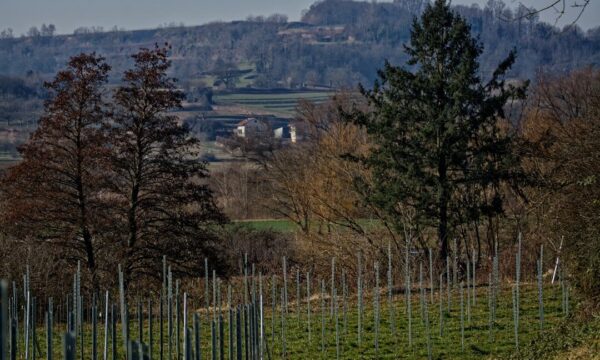
Kistenmacher-Hengerer
Kistenmacher-Hengerer is a Heilbronn estate where Trollinger leads a mixed Württemberg range. Compare its Riesling,…
Benchmark Wines from Württemberg
All Wines →Explore our wine catalog for bottles from this region.