Mittelrhein Wine Region
About Mittelrhein
The Mittelrhein is one of Germany’s smallest quality-wine regions, tracing roughly 120 kilometers of the Rhine between Bingen and Bonn. Riesling defines it, planted on steep terraces of Devonian slate that drop straight toward the water.
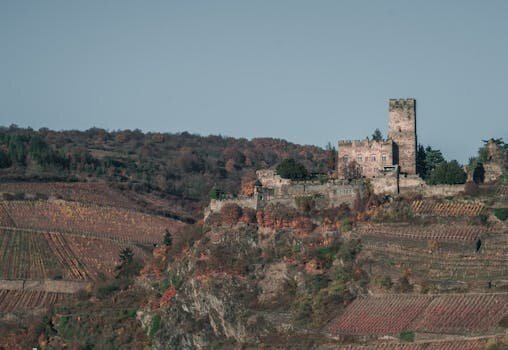
You have almost certainly seen these vineyards without knowing their name. They appear in nearly every photograph of the Rhine Gorge: narrow ledges of vines below ruined castles, the river bending past Boppard, the Loreley rock rising above the current.
Mittelrhein Riesling gives you lean, citrus-driven white wine with firm acidity and a stony edge, made in tiny quantities on slopes too steep for machines. Total plantings sit near 470 hectares. That scarcity is why these bottles rarely reach large retailers, and why the region stays underpriced compared with its neighbors.
By the end of this guide, you will be able to name the towns that matter, read a Mittelrhein label with confidence, and decide which style suits your table or your trip along the river.
Key Takeaways
- Mittelrhein runs about 120 km along the Rhine between Bingen and Bonn, with Riesling on roughly two-thirds of its small vineyard area.
- Devonian slate stores daytime heat and releases it at night, letting Riesling ripen this far north while keeping its taut, citrus-led profile.
- Bacharach, Bopparder Hamm, and Oberwesel are the three anchors for buying and visiting. Estate or village bottlings are the smartest first purchase.
How Do Geography and Climate Shape the Middle Rhine Gorge?
The gorge itself creates the growing conditions. Where the Rhine cut deep into old slate rock, it left steep walls that face the sun, hold heat, and shelter vines from cold wind. That protection is the main reason Riesling ripens reliably at this latitude.
Where the Mittelrhein Wine Region Begins and Ends
The Mittelrhein wine region stretches along the Rhine from Bingen north to Bonn, a distance of about 120 kilometers. Most of it lies in Rhineland-Palatinate, with a small section in Hesse near Lorch and Lorchhausen.
Growers split the valley in two. The Upper Middle Rhine Valley runs from Bingen and Rüdesheim to Koblenz and holds nearly all the serious Riesling. North of Koblenz, toward the Siebengebirge hills and Bonn, plantings thin out and soils shift toward pumice, greywacke, and volcanic rock.
Steep Terraces, River Reflection, and the Local Microclimate
Some slopes here exceed 60 percent grade, making this some of the most extreme vineyard land in Germany. Workers farm by hand or with winches, and each person covers only a fraction of the ground possible on flat land.
Three forces build the microclimate:
- South and southwest exposure catches the low northern sun at a favorable angle
- The river as a heat store warms the air in autumn and reflects light onto the terraces
- Dark slate absorbs warmth by day and radiates it back after sunset
Frost risk drops near the water, and the growing season lasts long enough for Riesling to build sugar while keeping its acidity. The same river valley dynamics operate across Germany’s cool-climate sites.
The UNESCO Upper Middle Rhine Valley as a Cultural Vineyard Landscape
UNESCO listed the Upper Middle Rhine Valley as a World Heritage site in 2002. The site covers the 65-kilometer stretch between Koblenz and Rüdesheim across Rhineland-Palatinate and Hesse, recognizing a landscape shaped by human hands: dry stone walls, terraces, and more than 40 hilltop castles.
That status protects the terraces but doesn’t pay for them. Steep-slope viticulture survives here because growers, often family estates working a few hectares, choose to keep the walls standing.
Why Does Devonian Slate Matter for Mittelrhein Riesling?
Slate is the practical engine of ripeness in this valley. It warms fast, drains hard, and forces vine roots deep through fractured rock, producing Riesling with tight structure and a dry, stony finish.
Rhenish Facies, Greywacke, and the Gorge’s Geological Foundations
The rock under these vineyards formed during the Devonian period, roughly 419 to 359 million years ago, when a shallow sea covered the area. Clay and sand sediments were buried, compressed, and folded into the layered slate and greywacke known as the Rhenish facies.
Later movement in the Carboniferous period tilted and lifted those beds. The Rhine then cut straight through them, exposing blue, grey, and red slate faces alongside harder bands of greywacke, a coarse sandstone that adds grit and drainage.
How Slate Soils Influence Ripening and Wine Structure
Slate soils are thin, poor in organic matter, and quick to shed water. Vines respond with small berries and modest yields, concentrating flavor and acid.
The heat effect is the decisive part. Dark stone soaks up radiation during the day and releases it overnight, adding effective warmth to the canopy at a latitude near the northern limit for wine grapes. Riesling in these conditions holds fresh acidity while reaching full physiological ripeness, a pattern also documented across the Mosel’s slate terroir.
Mittelrhein vs. Mosel and Rheingau: Similarities and Differences
The Mittelrhein shares its slate parentage with the Mosel, and the family resemblance shows: high acid, lower alcohol, a bright citrus core. Mittelrhein wines carry slightly more grip and a broader mid-palate, since the wide Rhine channel brings more direct sun than the tight Mosel meanders.
The Rheingau lies immediately upriver but takes a different path. Its south-facing shelf holds deeper loess, quartzite, and some slate, so its Rieslings run fuller and rounder, with more weight in dry Grosses Gewächs bottlings. Nahe and Rheinhessen sit further from this comparison, built on volcanic rock, quartzite, and limestone respectively.
What Does Mittelrhein Riesling Taste Like and Which Styles Are Made?
Expect a dry to off-dry white wine with high acidity, alcohol often between 11 and 12.5 percent, and flavors that run from lemon and green apple to yellow peach in warm years. Riesling accounts for roughly 63 to 68 percent of the region’s plantings, so most bottles you find will be Riesling.
The Typical Profile: Citrus, Orchard Fruit, Acidity, and Slate-Like Tension
Young Mittelrhein Riesling shows lime zest, white peach, and green apple, with a light floral lift. Acidity arrives firm and clean, pulling the finish long and dry even in wines with some residual sugar.
After five to ten years in bottle, the fruit turns toward quince and dried apricot, and a smoky, kerosene-tinged note appears. Good examples from ripe vintages hold well past a decade.
Trocken and Halbtrocken Riesling
Trocken means dry, legally up to 9 grams per liter of residual sugar when acidity supports it. These are the region’s everyday workhorses: sharp, saline-edged, and built for food.
Halbtrocken, or its cousin term Feinherb, means half-dry, sitting between 9 and 18 grams per liter. High acid keeps the sugar from reading as sweet, so a Halbtrocken can taste nearly dry. If you want to sort bottles by taste rather than guesswork, the mechanics of what makes German Riesling sweet or dry are worth learning once.
Kabinett, Spätlese, and Prädikat Explained
Prädikat terms record the Oechsle level, or sugar content, in the grapes at harvest, which reflects ripeness. They are not a sweetness scale for the finished wine.
- Kabinett: the lightest ripeness tier, low alcohol, made dry or fruity
- Spätlese: literally late harvest, riper grapes, more concentration, also made dry or fruity
- Auslese and above: selected ripe or botrytis-affected fruit, uncommon in the Mittelrhein
A Kabinett Trocken is dry. A Kabinett without Trocken on the label carries fruit sweetness. Read both words together.
Sekt and Other Grapes Grown in the Region
Many growers turn part of their Riesling crop into Sekt, German sparkling wine, and the high natural acid here suits bottle-fermented styles well. Traditional-method Riesling Sekt from the Mittelrhein rewards anyone exploring German Sekt as a category.
Beyond Riesling, you will find Müller-Thurgau (labeled Rivaner), Kerner, Weißburgunder (Pinot Blanc), and Grauburgunder (Pinot Gris) among the white wines. Reds are led by Spätburgunder (Pinot Noir), with Dornfelder and Portugieser planted in smaller amounts.
Which Wine Towns and Vineyards Define the Region?
Three places carry most of the Mittelrhein’s reputation: Bacharach with its steep amphitheater sites, Boppard with the region’s largest contiguous vineyard, and the Oberwesel-to-Sankt Goar corridor beneath the Loreley. Each sits within the UNESCO zone and shows a different face of the same slate.
Bacharach and Steeg: Historic Slopes Near the Southern Boundary
Bacharach sits near the southern edge of the region, below Burg Stahleck, a castle that changed hands repeatedly during the Thirty Years’ War. Its top Einzellage, the Bacharacher Hahn, covers roughly 8 hectares in a south-facing bowl carved into blue and grey Devonian slate.
The side valley at Steeg, just inland, brings cooler air and slightly later ripening. Wines from Steeg often show sharper acid and a leaner frame than those from the riverside slopes. Downriver, Burg Reichenstein marks another medieval stronghold that once controlled Rhine trade under the Holy Roman Empire.
Bopparder Hamm: The Rhine Bend and Its Extensive Vineyard Terraces
At Boppard, the Rhine makes its largest bend in the gorge, creating a long south-facing arc called the Bopparder Hamm — the biggest continuous vineyard in the Mittelrhein.
The bend gives the slope full southern exposure over several kilometers, with terraces stacked above the river. Rieslings from here tend to be riper and rounder than Bacharach’s, with more stone fruit and a softer acid line.
Oberwesel, Sankt Goar, and the Loreley Corridor
Between Oberwesel and Sankt Goar, the valley narrows and the Loreley rock rises about 130 meters above the water. This is the setting behind the Rhine legends that fed into Wagner’s Götterdämmerung.
The slopes here are steep, rocky, and often terraced in short steps. Oberwesel’s vineyards face south and southeast, producing taut, mineral-edged Riesling.
Sankt Goar has less vineyard land but shares the same slate. Farther south, Lorch and Lorchhausen sit in Hesse and straddle the boundary with the Rheingau.
Comparison Table: Bacharach, Bopparder Hamm, and Oberwesel
| Bacharach | Bopparder Hamm | Oberwesel | |
|---|---|---|---|
| Position in gorge | Southern Mittelrhein | Rhine bend near Koblenz | Mid-gorge, below Loreley |
| Key exposure | South, amphitheater bowl | South, long continuous arc | South to southeast |
| Soil | Blue and grey Devonian slate | Slate with greywacke bands | Slate, rocky and shallow |
| Typical style | Taut, citrus, firm acid | Riper, stone fruit, rounder | Lean, stony, high tension |
| Vineyard scale | Small, fragmented plots | Largest single site in region | Small terraced parcels |
| Landmark | Burg Stahleck | The Rhine bend | Loreley rock |
Which Producers, Pairings, and Buying Approaches Are Most Useful?
A handful of family estates carry the region’s reputation. Buying from them by village first, then by named Einzellage, offers the clearest way to learn the Mittelrhein.
Production is small, so plan on using specialist retailers, ordering directly from estates, or visiting in person.
Benchmark Estates: Weingut Ratzenberger, Toni Jost, Matthias Müller, and Lanius-Knab
Weingut Ratzenberger (Bacharach) works Steeg and Bacharach sites. The estate is known for traditional-method Riesling Sekt, along with dry and Prädikat wines.
Weingut Toni Jost (Bacharach) holds a large share of the Bacharacher Hahn and produces dry Riesling with clear site definition.
Weingut Matthias Müller (Spay, near Boppard) farms terraces in the Bopparder Hamm, with dry Riesling and Spätlese bottlings from the bend.
Weingut Lanius-Knab (Oberwesel) works steep parcels around Oberwesel, including older-vine plots.
Membership in a growers’ group, the Mittelrhein Riesling Charta, or a VDP association tells you about shared quality rules or organization, not about organic or biodynamic farming. Check each estate’s current certification directly.
Germany Rieslings keeps regional producer primers for exactly this kind of cross-checking.
How to Buy Mittelrhein Riesling by Origin and Style
Start with an estate wine (Gutswein) or a village wine from one producer. Learn its house style, then buy a single-vineyard bottling from the same estate.
Holding the producer constant while making the origin more specific shows what the site contributes. Simple comparison, but it works.
For a first purchase, a Bacharach Riesling Trocken from a strong vintage such as 2013, 2019, or 2021 gives a fair read on the region. Then compare it with a dry Riesling from the Rheingau or Mosel to place the style.
Food Pairings for Dry and Off-Dry Bottles
Dry Mittelrhein Riesling handles anything the acid can cut through:
- Oysters, sole, trout, and river fish
- Sushi and sashimi
- Roast chicken with lemon
- Fresh goat cheese
Halbtrocken and fruity Kabinett work with heat and spice: Thai curry, Sichuan dishes, pork with apple, or a smoked ham platter. The Riesling food pairing guide covers the sweetness-to-spice logic in more depth.
Wine Tasting and Vineyard Visits Along the Rhine
Most tastings happen at small estates or seasonal wine taverns called Strausswirtschaften, which serve their own wine with simple local food. Book estate visits ahead, since many are one- or two-person operations.
The Rheinburgenweg, or Rhine Castle Trail, runs along the left bank and passes directly through the terraces between Bingen and Koblenz. Rhine in Flames stages fireworks along the river on set dates each year, and trains from Mainz or Koblenz reach every wine town on this stretch.
Frequently Asked Questions
What is Mittelrhein Riesling known for?
It’s known for lean, high-acid white wine grown on steep Devonian slate terraces in the Rhine Gorge. The region covers roughly 470 hectares, making it one of Germany’s smallest, so bottles are scarce and often priced below comparable Mosel or Rheingau wines.
How is Mittelrhein Riesling different from Rheingau Riesling?
Mittelrhein Riesling is lighter, sharper, and more citrus-driven. Growers plant it almost entirely on slate at steep grades.
Rheingau Riesling comes from a broader south-facing shelf with loess and quartzite in the mix, giving it fuller body and more weight, especially in dry Grosses Gewächs bottlings.
What are the dominant grapes in the Mittelrhein wine region?
Riesling leads with roughly 63 to 68 percent of plantings. Müller-Thurgau (Rivaner), Kerner, Weißburgunder, and Grauburgunder fill out the whites, while Spätburgunder, Dornfelder, and Portugieser account for most of the red.
Is Prädikat a measure of sweetness in German Riesling?
No. Prädikat levels such as Kabinett and Spätlese record how much sugar the grapes held at harvest, which indicates ripeness.
A Kabinett labeled Trocken is fermented dry; the same Prädikat without Trocken will carry noticeable fruit sweetness.
Which Middle Rhine towns are best for winery visits and tastings?
Bacharach, Boppard, and Oberwesel offer the most estates within walking distance of a train station. Bacharach has the densest cluster of tasting rooms, while Boppard gives you direct access to the Bopparder Hamm terraces. Oberwesel, meanwhile, puts you at the foot of the Loreley corridor.
Want to read a German label without second-guessing it? Sign up for the free email mini-course, Master German Riesling in 7 Days, and work through labels, dry and off-dry pairings, and benchmark producers one short lesson at a time.
Viticultural Heritage & Terroir
Premier Wineries in Mittelrhein
All Wineries →Explore our winery directory for estates in this region.
Benchmark Wines from Mittelrhein
All Wines →Explore our wine catalog for bottles from this region.