Rheingau Riesling & Climate Change: Research and Adaptation
Climate change is reshaping Rheingau Riesling through earlier ripening and more frequent weather extremes, but it is not producing one uniform new style. Heat and drought can coincide with spring frost, heavy rain or humid disease pressure. Vineyard position, soil water capacity, canopy work and harvest timing determine how those pressures reach the bottle.
Rheingau climate change at a glance
- Warming can help ripening in a northern region, but rapid sugar accumulation can narrow the window for flavor and acidity decisions.
- Heat, drought and sunburn are important risks, especially where shallow soils or young roots provide little buffer.
- Rain remains consequential. Intense rainfall can cause runoff and erosion; humid periods can increase mildew and rot pressure.
- Adaptation is site-specific. Shade, ground cover, water management and picking decisions all involve trade-offs.
- Geisenheim is a research hub. Its vineyard trials study water, heat, carbon dioxide, soil biology and agrivoltaics rather than promising a single cure.
Why the Rheingau responds differently by site
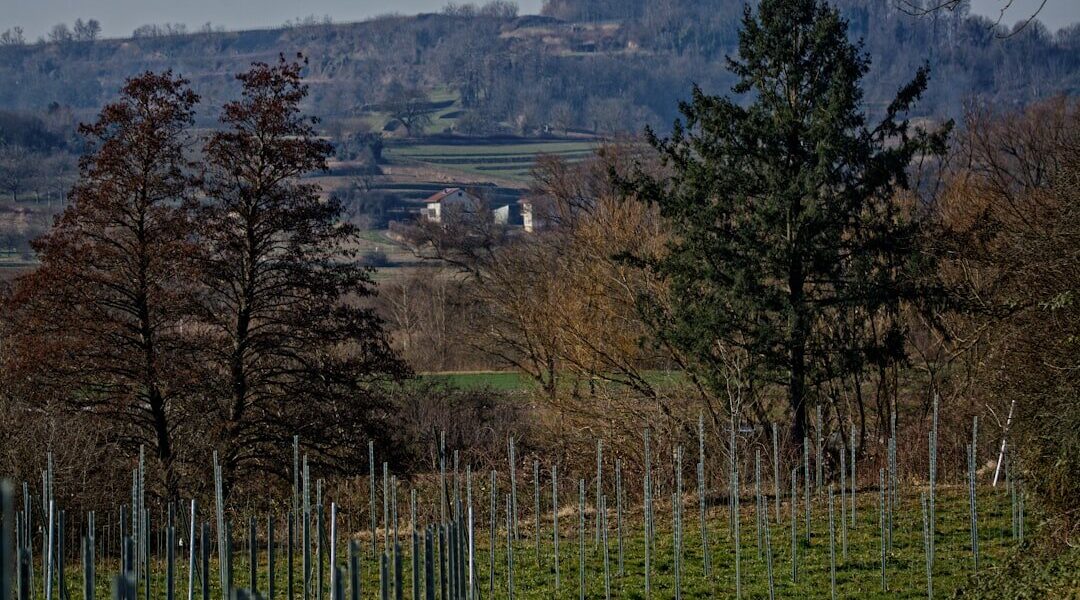
The Rheingau runs for roughly 50 kilometers along the right bank of the Rhine. Near Wiesbaden, the river bends west below the Taunus hills, placing many famous vineyards on sun-facing slopes protected from cold winds. The Rhine also influences the local mesoclimate. Farther west, the landscape narrows around Rüdesheim and Lorch, where elevation, exposure and soils change.
According to the German Wine Institute, the region had 3,117 hectares of vineyard in 2025, including 2,355 hectares of Riesling—the highest Riesling share of any German wine region. Its soils include loess, clay, sand, gravel, quartzite and slate. That diversity is why a heat wave or dry month cannot be translated into one regional bottle profile.
The main vineyard pressures
| Pressure | Potential effect | Management question |
|---|---|---|
| Earlier growth | Tender tissue may be exposed for longer before late-frost danger passes | How can pruning, site choice and frost planning reduce exposure? |
| Heat and sunlight | Berries can warm rapidly and suffer sunburn when suddenly exposed | How much fruit-zone shade is useful in this parcel and season? |
| Water deficit | Photosynthesis, berry development and young-vine establishment may be constrained | How do soil depth, roots, cover vegetation and permitted water use interact? |
| Heavy rain | Runoff, erosion and access problems can increase | Which ground cover and drainage strategy fits the slope? |
| Humidity and disease | Mildew and rot pressure can force rapid canopy and harvest decisions | How can airflow and crop protection be managed without exposing fruit to excess heat? |
These pressures can conflict. Removing leaves can improve airflow after rain but also expose grapes to intense sunlight. Permanent cover can protect soil yet compete with vines for scarce water. Delaying harvest can build flavor, while waiting too long may sacrifice acidity or increase disease risk. Responsible adaptation starts with measurement and observation, not universal instructions.
What Hochschule Geisenheim is testing
Hochschule Geisenheim University sits inside the Rheingau and maintains research vineyards. Its vine–environment program examines temperature, rainfall, light, carbon dioxide, vine physiology, berry composition, yield stability and water supply. That breadth matters because climate change is not only a temperature problem.
Elevated carbon dioxide and water
The VineyardFACE facility grows Riesling and Cabernet Sauvignon in open-air plots with elevated carbon dioxide. Geisenheim reports that its early years included sharply different extremes: 2015 was exceptionally warm, while January–June 2016 was the wettest recorded at the site since 1885. That contrast is a useful warning against treating one vintage as a permanent trend. The experiment investigates physiology, growth, pests, yield and berry composition under future atmospheric conditions.
Drought, soil and roots
Current Geisenheim projects are studying soil microbiomes, rootstocks and vine fitness under low-water conditions in Rheingau soils. Long-term comparisons of integrated, organic and biodynamic systems also examine rooting, soil-moisture dynamics and vine physiology. These are active research questions; they do not justify claims that one certification or commercial input automatically makes a vineyard climate-resilient.
Agrivoltaics
Geisenheim’s VitiVoltaic project places adjustable, semi-transparent solar modules above vines. Researchers are testing whether shade and weather protection can moderate berry temperature, water stress, heavy-rain damage and canopy humidity while generating electricity. Because the project is designed to answer those questions, it should be described as a trial—not as proof that panels already preserve acidity, cut pesticide use by a fixed percentage or suit every Rheingau landscape.
What warming can mean in the glass
Warmer conditions can encourage riper fruit and faster sugar accumulation, while Riesling’s naturally prominent acidity remains central to balance. Yet finished alcohol and sweetness are not dictated by weather alone. Harvest date, grape health, fermentation and blending choices can lead to dry, off-dry or fruit-sweet wines from the same season.
Avoid rigid flavor forecasts such as “warm equals tropical” or “cool equals ageworthy.” Site and producer evidence is more useful. For current releases, compare the wine’s label, alcohol level and technical sheet, then read the producer’s account of the vintage. Our German Riesling label guide explains trocken, Prädikat and origin terms.
A climate-aware buying checklist
- Identify the site. Elevation, exposure, soil and position within the Rheingau can matter more than a regional headline.
- Check the style. Do not infer sweetness or alcohol from “warm vintage”; read the label and stated ABV.
- Look for producer detail. Harvest and technical notes can explain picking, sorting and the intended style.
- Buy across vintages to learn. Comparing the same producer or vineyard is more informative than treating a year as universally great or poor.
- Skip investment predictions. Climate adaptation does not guarantee rarity, resale value or a particular aging window.
For estate context, use our Rheingau producer guide. For a regional comparison, see Mosel Riesling and climate change.
Sources
- German Wine Institute: Rheingau region profile and 2025 vineyard data
- German Wine Institute: climate and weather in German wine regions
- Hochschule Geisenheim: vine–environment interaction research
- Hochschule Geisenheim: VineyardFACE experiment
- Hochschule Geisenheim: agrivoltaics in the vineyard
- Hochschule Geisenheim: current viticulture research projects
Frequently asked questions
How is climate change affecting Rheingau Riesling?
It can advance ripening and reduce some historic cool-climate constraints, while increasing exposure to heat, drought, sunburn, heavy rain, disease pressure and early-season frost. The effect on a wine depends on the site, season and producer decisions rather than warming alone.
Will Rheingau Riesling lose its acidity?
Not automatically. Warmer conditions can accelerate sugar accumulation and reduce acidity during ripening, but Riesling naturally retains marked acidity and growers can respond through site selection, canopy management and harvest timing. Judge the finished wine, not a regional stereotype.
What is Geisenheim researching for climate adaptation?
Hochschule Geisenheim studies vine–environment interactions, water supply, berry heat, elevated carbon dioxide, soil health, drought response and agrivoltaics. Several projects are active trials, so their possible benefits should not be presented as established results for every vineyard.
Are solar panels already a standard solution in Rheingau vineyards?
No. Hochschule Geisenheim is testing agrivoltaic systems to learn how panel shade, water balance, weather protection, vineyard work and power generation interact. It is a research pathway, not a region-wide standard or guaranteed commercial answer.
Is a cooler Rheingau vintage always better for aging?
No. Cooler and warmer years can both produce ageworthy wine. Balance, concentration, style, harvest decisions, closure and storage are more useful than a simple temperature label or fixed vintage rule.
Germany Rieslings Editorial Team
German Wine Editorial ReferenceResearched, structured, and fact-checked against official Deutsches Weininstitut (DWI) documentation, German Federal Wine Law (Weingesetz), and VDP.Die Prädikatsweingüter standards.