Maximin Grünhaus
Estate Overview & Philosophy
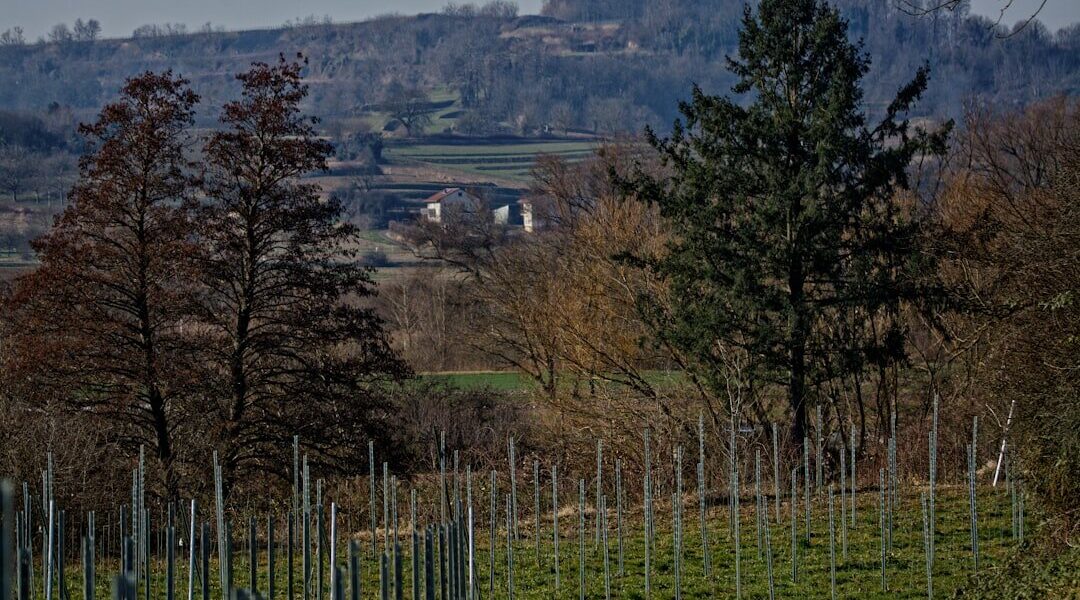
Maximin Grünhaus is a historic Ruwer VDP estate in Mertesdorf, its reputation built on three contiguous monopole Grosse Lage vineyards: Abtsberg, Herrenberg and Bruderberg.
The estate reports 34 hectares planted to 90% Riesling, 5% Pinot Noir and 5% Pinot Blanc. The three vineyard names descend from the old monastery hierarchy, each marking a distinct section of one enclosed slope above the Ruwer.
Maximin Grünhaus at a glance
| Base | Mertesdorf, Ruwer |
|---|---|
| Current generation | Maximin and Amelie von Schubert |
| Reported area | 34 ha |
| Grape mix | 90% Riesling, 5% Pinot Noir, 5% Pinot Blanc |
| Monopole sites | Abtsberg, Herrenberg and Bruderberg |
| Site status | All three are VDP.Grosse Lage |
| VDP membership | Current member |
Estate history and identity
The Grünhaus name surfaces in documents from the 10th century. For nearly a millennium the property belonged to Trier’s Benedictine Abbey of St. Maximin, until secularization brought its sale in 1811.
The von Stumm-Halberg family acquired the estate in 1881. Marriage carried it to the von Schubert family, whose sixth generation now runs the property, according to the official estate history.
This history resists compression into a tidy “founded 966” data point. A first documentary mention is not a modern founding date, so we’ve removed that structured field rather than repeat an inaccuracy.
Vineyards and origin
Abtsberg covers roughly 14 hectares. It is the steepest of the three, with exposure swinging from southeast to southwest across its face.
Herrenberg, at about 19 hectares, sits more sheltered by forest — generally cooler and gentler in gradient. Bruderberg, the smallest at roughly one hectare, faces east. All three remain estate monopoles.
A vineyard name is a claim of origin, not a guarantee of flavor. Aspect, elevation, water supply and Devonian slate all shape growing conditions — but vintage, picking decisions, fermentation, residual sugar and bottle age shape the wine just as much.
Treat site descriptions as a framework for comparison, not as proof that slate itself pours directly into the glass.
Wine range and cellar approach
The range spans dry, feinherb and Prädikat Riesling, alongside smaller volumes of Pinot Noir and Pinot Blanc. Since 2022 the estate has foregrounded its historical Abtsberg–Herrenberg–Bruderberg hierarchy on labels — meaning the exact site and style terms matter more than ever when buying.
The estate states that all 34 hectares ferment spontaneously, alongside cover crops and intensive canopy management. These are current estate-level practices — not confirmation that every bottling shares identical vessel, lees contact or sulfur treatment.
How to buy Maximin Grünhaus
For a controlled site comparison, choose Abtsberg and Herrenberg Rieslings from the same vintage and sweetness category. Bruderberg’s tiny volume makes it harder to source.
Resist applying a single Ruwer aging window across all three sites or wine styles — each behaves differently in bottle.
- Choose sweetness first. Look for Trocken, Feinherb, a Prädikat, or the producer’s technical sheet; a vineyard name alone reveals nothing about residual sugar.
- Then choose origin. Gutswein, Ortswein and Einzellage bottlings answer different questions — they are not interchangeable price tiers.
- Check the exact vintage and AP number. These identify the specific harvest and approved bottling; don’t transfer one review to a similarly labeled wine from another year.
- For older bottles, buy provenance. Storage conditions, fill level, closure integrity and seller reputation matter more than a generic aging promise.
VDP and label context
As a VDP member, the estate may draw on the association’s four-tier origin system: Gutswein, Ortswein, Erste Lage and Grosse Lage. Grosse Lage names the highest classified site; Grosses Gewächs, or GG, denotes the dry wine from that site.
Fruit-sweet wines from a Grosse Lage instead carry Prädikat terms — Kabinett, Spätlese, Auslese. Our German Riesling label guide unpacks the wider system.
Visiting and current information
The official estate site lists current tasting and visit arrangements for Maximin Grünhaus 1 in Mertesdorf. Appointment rules, shop hours, releases and shipping markets shift over time — confirm details directly with the estate shortly before you plan to act.
Reviewed Estate Bottlings & Tasting Archive
Explore detailed tasting reviews, vintage evaluations, and vineyard profiles for benchmark bottlings from this estate:
Sources
Profile checked against the linked primary sources in August 2026. Estate details can change.
Frequently asked questions
What is Maximin Grünhaus known for?
u003cpu003eThree Ruwer monopoles—Abtsberg, Herrenberg and Bruderberg—and a range spanning dry, feinherb and Prädikat Riesling.u003c/pu003e
Is Maximin Grünhaus a VDP member?
u003cpu003eYes. Maximin Grünhaus appears in the current VDP grower directory. VDP is a private growers’ association with its own origin classification, not a synonym for German wine law.u003c/pu003e
Which vineyards matter most at Maximin Grünhaus?
u003cpu003eAbtsberg, Herrenberg and Bruderberg are contiguous estate monopoles and all are classified VDP.Grosse Lage.u003c/pu003e
Can you visit Maximin Grünhaus?
u003cpu003eVisit and tasting arrangements change. Use the estate’s official website immediately before travel and book where requested; don’t rely on an old article for opening hours, prices or walk-in availability.u003c/pu003e