Wehlener Sonnenuhr vs Bernkasteler Doctor: Site & Wine Guide

Wehlener Sonnenuhr and Bernkasteler Doctor are both celebrated Middle Mosel Riesling sites, both classified VDP.Grosse Lage, but they diverge sharply in scale, position, and the range of producers through which buyers can explore them. Wehlener Sonnenuhr is a broad, steep southwest-facing slope across the Mosel from Wehlen; Bernkasteler Doctor is a tiny, precipitous parcel rising directly above Bernkastel’s old town.
The comparison in one minute
- Classification: both are VDP.Grosse Lage; neither name by itself signals a dry wine.
- Scale: Wehlener Sonnenuhr spans roughly 40–46 hectares in the VDP’s published material; Bernkasteler Doctor covers about 3.2 hectares.
- Setting: Sonnenuhr climbs opposite Wehlen; Doctor sits directly above Bernkastel’s old town.
- Soil: both are rooted in weathered Devonian slate, though the VDP describes Doctor as having more fine earth.
- Buying difference: Sonnenuhr offers a wider field of producers; Doctor is far smaller and represented by fewer estates in the VDP directory.
Wehlener Sonnenuhr vs Bernkasteler Doctor: facts at a glance

| Feature | Wehlener Sonnenuhr | Bernkasteler Doctor |
|---|---|---|
| Location | Steep slope across the Mosel from Wehlen | Steep slope directly above Bernkastel’s historic center |
| VDP category | VDP.Grosse Lage | VDP.Grosse Lage |
| Published size | Approximately 40–46 ha in VDP material | Approximately 3.2 ha |
| Aspect | Predominantly southwest to south-southwest | South-southwest to south |
| Elevation | Approximately 110–320 m | Approximately 130–190 m |
| Steepness | Extremely steep; the VDP profile gives about 65–70% for its classified parcel | Up to about 70% |
| Soil | Grey-blue weathered Devonian slate | Blue and grey weathered Devonian slate with more fine earth |
| Producer access | Many estates and a broad range of bottlings | Far fewer bottlings from a very small site |
The VDP’s English Sonnenuhr page gives 46 hectares in its data panel, while its narrative describes the broader site as about 40 hectares. Treat these figures as approximate rather than combining them into false precision. The practical contrast remains unambiguous: Bernkasteler Doctor is only a small fraction of Sonnenuhr’s area.
Wehlener Sonnenuhr: a large landmark site

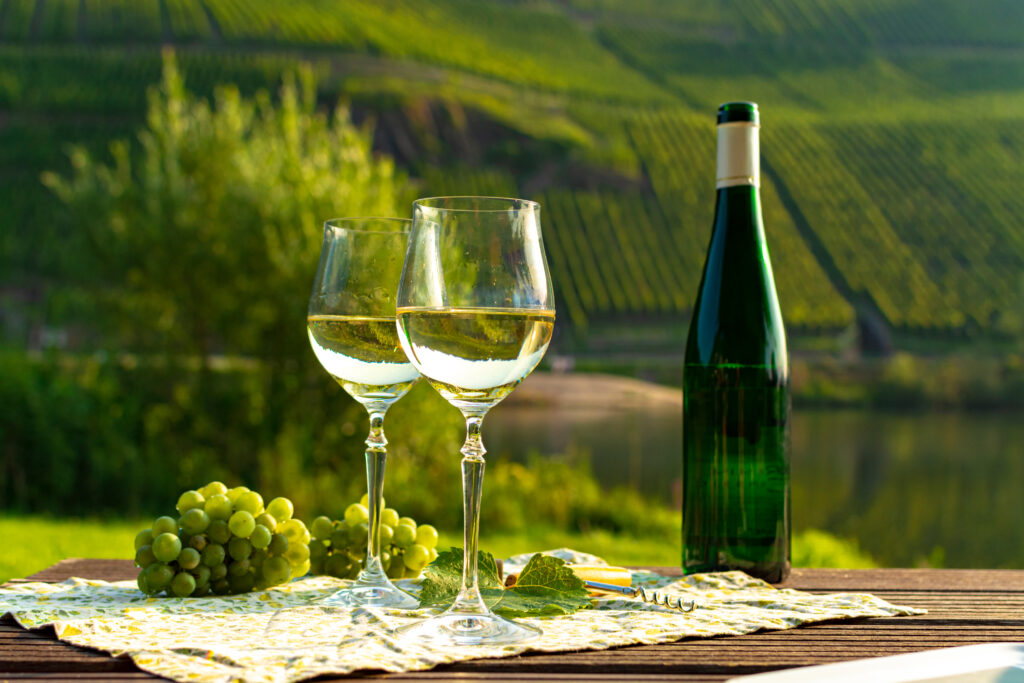
Wehlener Sonnenuhr occupies a long, steep stretch of the Mosel slope opposite the village of Wehlen. Its southwest orientation gives vines substantial afternoon exposure, while the river and steep valley shape local light, air movement, and temperature. The VDP describes grey-blue Devonian slate, with Riesling as the sole permitted grape in its Grosse Lage parcel.
The famous sundial is part of the site’s identity, but it was no ancient Roman timepiece. The Prüm family’s Jodocus website dates its construction to 1842, installed by Jodocus Prüm to help vineyard workers tell the time. The site was formerly known as Lammerterlay; the sundial became the more memorable landmark, and the name stuck.
Sonnenuhr is not a monopole. The VDP directory currently names Reichsgraf von Kesselstatt, Dr. Loosen, Joh. Jos. Prüm, S.A. Prüm, Willi Schaefer, Schloss Lieser, Wegeler Mosel, and Van Volxem among its member growers. This breadth is useful to buyers: it makes the site an excellent place to compare producer interpretation, vintage, and sweetness level without changing the named vineyard.
Bernkasteler Doctor: a tiny slope above town

Bernkasteler Doctor lies directly above Bernkastel’s old town. The VDP profile puts the classified area at roughly 3.2 hectares, facing south-southwest to south and rising from about 130 to 190 meters. It describes dark, stony weathered Devonian slate, blue and grey slate components, more fine earth than in many neighboring sites, and predominantly ungrafted vines.
The familiar story that the vineyard’s wine cured a sick medieval archbishop is legend, not documented medical history. The VDP distinguishes that tale from a later, verified connection: it reports that Britain’s Edward VII drank Bernkasteler Doctor as medicine. Neither story proves a health benefit, and wine should never be presented as treatment.
Doctor is not a monopole. The VDP’s current vineyard directory lists Schloss Lieser–Thomas Haag, Wwe. Dr. H. Thanisch Erben Thanisch, and Wegeler Mosel among its member growers. Because the VDP is a private association, read that list as its member directory rather than a complete land-registry statement.
Do the sites have a guaranteed taste?

No. Writers often describe Sonnenuhr as delicate or floral and Doctor as powerful or spicy, but these are tasting conventions, not enforceable site specifications. Harvest date, yields, botrytis, fermentation, residual sugar, alcohol, élevage, vintage, and bottle age can all reshape the result. Slate should never be treated as a flavor ingredient that passes directly into the wine.
A useful comparison holds as much constant as possible: taste the same vintage, similar Prädikat or dry category, and preferably wines at comparable stages of bottle age. A Sonnenuhr Kabinett and a Doctor Auslese do not isolate vineyard character — they compare different ripeness and sweetness decisions too.
How to read the labels

Both names identify vineyard origin. Neither guarantees sweetness, alcohol, or a single quality level. Under the VDP system, Grosse Lage is the highest classified site category. A dry wine from a VDP.Grosse Lage may be labeled Grosses Gewächs, usually abbreviated GG; fruit-sweet wines carry traditional Prädikat terms such as Kabinett, Spätlese, or Auslese.
Read the complete label in this order: producer, vintage, village and vineyard, trocken or GG if present, Prädikat if present, alcohol, and AP number. Our Grosse Lage vs Grosses Gewächs guide explains the distinction, and the German Riesling label guide covers the other terms.
How to choose between them

- Choose the style first. Decide whether you want dry, off-dry, or fruit-sweet Riesling before weighing vineyard prestige.
- Compare the exact producer. A grower’s farming, picking, and cellar decisions can matter as much as the site name.
- Check the vintage and technical sheet. Never infer residual sugar or alcohol from the vineyard alone.
- Consider availability. Doctor’s tiny area makes it scarcer; scarcity is no proof a bottle will suit your palate or rise in value.
- Check provenance for mature bottles. Fill level, closure, storage, and seller reputation matter more than any generic aging chart.
There is no responsible fixed price band or universal drinking window for either vineyard. Entry-level and auction bottlings, dry and sweet wines, current and mature releases — each occupies a different market. Buy the bottle, not the legend.
Visiting the vineyards

Both slopes are working agricultural sites, not open-air tasting rooms. Public viewpoints, roads, and marked paths offer excellent perspectives, but access conditions can change during vineyard work, harvest, or bad weather. Respect signs and private parcels, wear suitable footwear, and arrange winery visits directly with producers rather than assuming walk-in access or a fixed tour fee.
Frequently asked questions
Which is better: Wehlener Sonnenuhr or Bernkasteler Doctor?
Neither vineyard is universally better. Bernkasteler Doctor is much smaller and usually scarcer, while Wehlener Sonnenuhr offers more producers and styles to compare. Choose the producer, vintage, and sweetness category that fit the bottle you want rather than treating the site name as a score.
Are Wehlener Sonnenuhr and Bernkasteler Doctor both Grosse Lage vineyards?
Yes. The VDP classifies both as VDP.Grosse Lage, its highest vineyard category. Grosse Lage describes the classified origin; Grosses Gewächs or GG describes a dry wine made from a Grosse Lage under VDP rules.
Is Bernkasteler Doctor a monopole?
No. The VDP vineyard directory currently lists Schloss Lieser–Thomas Haag, Wwe. Dr. H. Thanisch Erben Thanisch, and Wegeler Mosel for Bernkasteler Doctor. A directory of VDP members should not be mistaken for a complete legal ownership register.
Who makes wine from Wehlener Sonnenuhr?
Multiple estates work in Wehlener Sonnenuhr. The VDP directory currently lists Reichsgraf von Kesselstatt, Dr. Loosen, Joh. Jos. Prüm, S.A. Prüm, Willi Schaefer, Schloss Lieser, Wegeler Mosel, and Van Volxem among its member growers. Other producers may also bottle the site.
Which vineyard makes Riesling that ages longer?
The vineyard name alone cannot answer that. Sweetness, acidity, concentration, vintage, producer choices, closure, and storage history all affect development. Compare the exact bottlings and producer guidance rather than applying one fixed drinking window to either site.
Sources
Germany Rieslings Editorial Team
German Wine Editorial ReferenceResearched, structured, and fact-checked against official Deutsches Weininstitut (DWI) documentation, German Federal Wine Law (Weingesetz), and VDP.Die Prädikatsweingüter standards.