Pfalz Riesling Vintage Chart: 2021–2025 Buying Guide

A useful Pfalz Riesling vintage chart separates documented growing conditions from unsupported ratings and fixed drinking windows. Germany’s second-largest wine region spans the Mittelhaardt and Südliche Weinstraße. Rainfall, frost, soil and harvest pressure vary materially between north and south, so a single regional score rarely tells the whole story.
How to use this vintage chart
- Start with the exact wine. Producer, vineyard, style, harvest choices and storage matter more than a regional score.
- Use the year as context. The chart summarizes growing conditions and likely buying questions. It does not promise quality or a drinking window.
- Separate styles. Dry Riesling, Kabinett, Spätlese and noble-sweet wine from the same year can develop very differently.
- Treat 2025 as provisional. The wines are young, and early regional reports cannot replace tasting the finished bottling.
Pfalz Riesling vintage chart: 2021–2025
| Vintage | Documented conditions | Evidence-based style outlook | What to check before buying |
|---|---|---|---|
| 2025 | Small berries, rapid ripening and many varieties reaching maturity together. Harvest ended on 23 September, before rain complicated later picking. | Regional reporting described healthy grapes, concentrated flavor and high must weights, with structure and potential in top lots. | Ask whether the fruit arrived before or after mid-September rain, and how the producer managed the compressed harvest. |
| 2024 | Patchy frost, a cool delay, repeated summer rain and high mildew pressure. Overall losses were less severe than in several other regions. | Northern Pfalz Riesling was highlighted for fine fruit, fine acidity and relatively low alcohol — a more classic profile than recent hot years. | Check whether the wine comes from northern Riesling country or the more mixed Südpfalz, and avoid a region-wide score. |
| 2023 | Drought followed by substantial rain and warm September weather compressed picking and increased the need for healthy-fruit selection. | Young wines nationally were described as fruit-driven, relatively lean and marked by fine acidity. Bottle results depend on timing and sorting. | Look for harvest and sorting detail, particularly where compact bunches or late rain increased pressure. |
| 2022 | The sunniest German summer on record brought heat and drought before September rain. Young vines were especially vulnerable. | White wines were generally fresh and fruit-led, often less acidic than 2021 and accessible earlier. | Compare cooler forest-edge sites with warmer exposed parcels, and check finished alcohol and balance. |
| 2021 | A wetter, cooler year required sustained disease control and careful selection during a later harvest. | Freshness and moderate alcohol can be attractive, but regional conditions alone do not establish longevity. | Producer discipline and grape health are more useful than assuming every 2021 is automatically superior. |
The 2021 and 2022 rows draw on the German Wine Institute’s detailed national and regional harvest reports. The 2023–2025 rows use DWI’s regional summaries, which incorporate reporting from the relevant growers’ associations and state wine services. They describe the harvest, not every finished wine.
Why Pfalz needs a regional lens
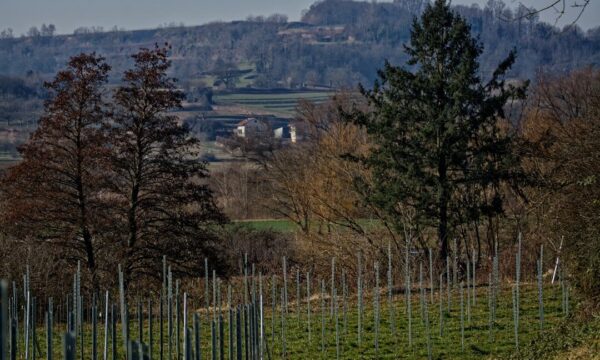
The Pfalz lies in the rain shadow of the Pfälzerwald and runs along the German Wine Route. Riesling is especially important in the north around the Mittelhaardt, while the larger region supports many white and red varieties.
Warmth and relative dryness help ripening, but water supply, soil and site exposure still shape how a hot year performs.
Regional contrast mattered in 2024: the Südpfalz reported a substantially smaller crop, while experts highlighted northern Pfalz Riesling for fine fruit, acidity and lower alcohol. In 2025, many grapes ripened together and the harvest ended earlier than ever, making logistics and picking date critical evidence for the finished style.
How to compare bottles within a vintage
- Decode the label. Identify the producer, origin, Prädikat or dry designation and alcohol level with our German Riesling label guide.
- Read a technical or harvest note. Look for picking date, sorting, grape health and intended style rather than marketing superlatives.
- Compare like with like. A regional estate wine and a single-vineyard Grosses Gewächs are not interchangeable evidence for a year.
- Check provenance for older wine. Fill level, closure, temperature history and seller recourse become increasingly important with age.
- Taste before buying multiples. Vintage summaries cannot predict your preference for acidity, ripeness, sweetness or bottle development.
What about 2001–2020?
This page previously assigned every year from 2001 onward a star score and a fixed peak window. That presentation implied bottle-level certainty the source material could not support.
Wines from those vintages now range from recently mature to more than two decades old, so condition and provenance can outweigh a generalized harvest reputation.
For 2001–2009, use the mature German Riesling buying and opening guide. For 2010–2024 national context, see the German Riesling vintage guide. Neither replaces an inspection of the exact bottle.
Aging without false precision
Residual sugar, acidity, concentration, alcohol, closure and storage all influence development. A basic dry Riesling made for early drinking should not inherit the projected life of a top dry vineyard wine, and a Kabinett should not inherit the window of a Beerenauslese.
Use our Riesling aging guide as a framework, then apply producer and bottle evidence on top.
Sources
- German Wine Institute: 2025 vintage in the 13 wine-growing regions
- German Wine Institute: 2024 regional vintage report
- German Wine Institute: detailed 2023 regional report
- German Wine Institute: detailed 2022 regional report
- German Wine Institute: detailed 2021 regional report
Frequently asked questions
What is the best recent Pfalz Riesling vintage?
u003cpu003eNo year is best for every style. Buyers seeking a fresher profile may appreciate well-made 2021 or 2024 wines, while 2022, 2023 and 2025 reflect different warm-season and harvest pressures. Compare the exact site and producer.u003c/pu003e
What is special about 2024 Pfalz Riesling?
u003cpu003eDWI’s regional report highlighted northern Pfalz Riesling for fine fruit, fine acidity and lower alcohol after a wet, demanding season. That is a regional outlook, not a guarantee for every bottle.u003c/pu003e
What should buyers expect from 2025 Pfalz Riesling?
u003cpu003eThe year brought small berries, high ripeness and an exceptionally early finish to harvest. Producers who picked healthy fruit before rain may have strong material, but finished wines still need bottle-level evaluation.u003c/pu003e
Do warm Pfalz vintages always make high-alcohol Riesling?
u003cpu003eNo. Site, picking date, yield, fermentation and residual sugar all affect alcohol and balance. Read the stated ABV and technical information instead of inferring style from weather alone.u003c/pu003e
How long can Pfalz Grosses Gewächs age?
u003cpu003eSome top examples can develop for many years, but no region-wide window is reliable. Producer, vineyard, vintage, closure and storage determine the individual bottle.u003c/pu003e
Related regional guides
Germany Rieslings Editorial Team
German Wine Editorial ReferenceResearched, structured, and fact-checked against official Deutsches Weininstitut (DWI) documentation, German Federal Wine Law (Weingesetz), and VDP.Die Prädikatsweingüter standards.