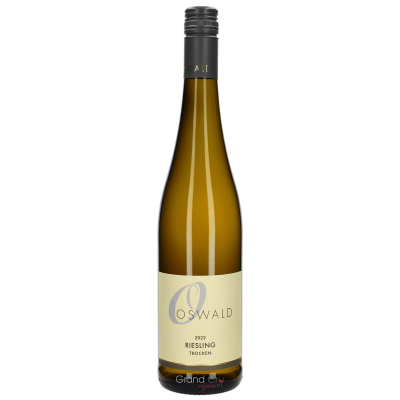
2022 Weingut Oswald Riesling Trocken
Wine Profile & Character
The Oswald bottling from Weingut Wittmann draws on parcels surrounding the estate’s home base in Westhofen, a village whose name carries considerable weight among Rheinhessen‘s dry Riesling producers. The vines here sit on a patchwork of shell limestone and clay-loam, soils that impart a distinct chalky backbone even to the estate’s entry-tier cuvées. Wittmann has farmed biodynamically since the early 2000s, and that philosophy shows in the restraint of this wine: no attempt to over-extract, no reliance on new oak or heavy lees stirring to build weight artificially. Instead, the fruit is allowed to express the cooler nights and limestone-inflected soils of this corner of Rheinhessen, giving a wine that reads as lean, precise, and unmistakably terroir-driven rather than merely varietal.
On the nose, the wine opens with green apple, white peach, and a whisper of quince, layered over a stony, almost flinty minerality that becomes more pronounced with aeration. The palate is taut and linear, driven by a spine of racy acidity that Wittmann’s limestone sites reliably deliver even in warmer vintages like 2022. Citrus pith and unripe pear carry through the mid-palate, while a saline, wet-stone undertone lends gravity beneath the fruit. There is no residual sweetness to cushion the structure — this is a wine built on tension, where acid and mineral texture do the work that fruit concentration might in a warmer-climate Riesling.
2022 was a vintage of generous ripeness balanced by enough diurnal swing to preserve acidity, and this wine reflects that duality — approachable now, but with enough structural backbone to reward two or three years in bottle. Over that time, the primary orchard-fruit character will recede slightly, allowing the limestone minerality and a subtle honeyed complexity to move to the fore. This is not a wine built for extended cellaring, but it will gain textural roundness and aromatic nuance through 2028 before its youthful vigor begins to soften.
Sourced Profile
Compiled from producer and published descriptions, not a firsthand tasting by our team.
Appearance: Pale straw-yellow with a hint of green at the rim, brilliantly clear with a fine, steady brightness typical of well-made Rheinhessen dry Riesling.
Aromas & Bouquet: Green apple, white peach, and quince skin lead, framed by citrus zest and a distinct chalky, wet-stone minerality. A faint floral lift of white blossom emerges with air, giving the aromatics a clean, orchard-driven character rather than tropical richness.
Palate & Structure: Bracing, linear acidity forms the wine's core, carrying citrus pith, unripe pear, and a touch of green herb across the mid-palate. Texturally taut rather than plush, with a saline, stony undercurrent that grounds the fruit and prevents any sense of simplicity. Dry through and through, with no residual sweetness to blunt its precision.
Finish & Longevity: The finish is medium in length, closing on a mineral, saline note with light phenolic grip that lends structure without bitterness. A faint citrus pith bitterness lingers cleanly, encouraging another sip.
Food Pairings
Pair with pan-seared trout or sole in brown butter, where the wine's acidity cuts through the richness while echoing the fish's delicacy. It also excels alongside a classic Rheinhessen dish of Handkäse mit Musik or a simple goat cheese salad, where its citrus and mineral notes complement tangy, lactic flavors. For a lighter option, try it with steamed mussels in white wine broth or a green herb risotto, both of which mirror the wine's saline and herbaceous undertones.
Cellaring & Ageability
Best enjoyed between 2026 and 2030, with peak drinking in the first two to three years after release. Expect the fruit to soften and the mineral, saline character to gain prominence, though this is a wine designed for youthful vitality rather than long-term cellaring.