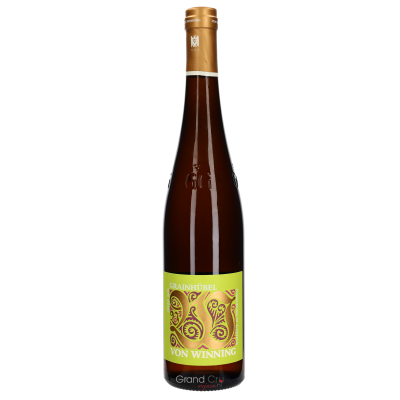
2022 Weingut von Winning Grainhübel Riesling Trocken Grosses Gewächs
Wine Profile & Character
The Grainhübel vineyard in Deidesheim occupies one of the Mittelhaardt’s most storied slopes, a site whose name—translating loosely to “grainy hill”—refers to the weathered sandstone and limestone-flecked colluvium that underpins its soils. Unlike the pure slate of the Mosel, this Pfalz terroir marries chalky limestone with sandy loam and scattered fragments of buntsandstein, lending the wines a structural firmness rather than a purely mineral austerity. Von Winning, under the guidance of Stephan Attmann, farms Grainhübel with a philosophy borrowed as much from Burgundy as from tradition here: whole-cluster pressing, extended lees contact, and fermentation and aging in large old oak Stück casks that allow the site to speak without the imprint of new wood. This is viticulture in service of transparency, coaxing tension and gravitas from a vineyard that ripens slowly under the moderating influence of the Haardt mountains.
The 2022 Grainhübel GG opens with a reticent but promising nose, requiring patience in the glass before yielding pressed grapefruit, quince, and a distinct wet-stone character that speaks directly to its calcareous foundation. Beneath this sits a savory, almost saline undertone, along with hints of chamomile and white pepper that emerge as the wine warms. On the palate, the texture is dense yet buoyant, a hallmark of von Winning’s barrel-aged Rieslings—there is a creamy, almost phenolic weight from lees contact, held in check by the wine’s 7.1 g/L acidity, which cuts through with laser precision. Flavors evolve from citrus pith and green apple in the attack toward a deeper core of stone fruit and crushed rock in the mid-palate, with the modest 5.1 g/L residual sugar folding invisibly into the structure rather than registering as sweetness.
2022 was a vintage of contrasts in the Pfalz—early heat and drought stress balanced by cool nights and well-timed rainfall that preserved acidity in top sites like Grainhübel. This is a wine built for the cellar: its youthful compression and slightly closed aromatics belie the depth coiled within. Over the next decade, expect the primary citrus to recede in favor of dried fruit, beeswax, and a more pronounced saline minerality, with the wine gaining textural harmony as the oak and lees integration fully resolves.
Sourced Profile
Compiled from producer and published descriptions, not a firsthand tasting by our team.
Appearance: Pale straw-gold with a faint greenish reflex at the rim, the wine pours brilliantly clear with a slight viscosity visible on the glass.
Aromas & Bouquet: Initially reserved, the bouquet slowly unfurls to reveal pressed grapefruit, quince paste, and wet limestone, layered with subtle notes of chamomile, white pepper, and a faint smoky flint. With aeration, a creamy lees-derived richness emerges, adding depth without obscuring the site's mineral signature.
Palate & Structure: The entry is dense and textural, coating the palate with a near-phenolic grip before the acidity asserts itself with surgical precision. Flavors move from citrus pith and green apple through to white peach and crushed stone, the residual sugar seamlessly absorbed into the wine's structural backbone. There is a chalky, tactile quality throughout that speaks unmistakably of Grainhübel's limestone foundation.
Finish & Longevity: The finish is long and saline, with a persistent mineral grip that lingers alongside notes of citrus zest and stone. Fine phenolic texture frames the close, leaving the palate refreshed rather than fatigued.
Food Pairings
This wine's density and acid structure make it an excellent match for Alsatian choucroute garnie, where the wine's cutting acidity balances rich, fatty pork. Grilled turbot with beurre blanc echoes the wine's creamy texture, while a saffron-scented bouillabaisse plays beautifully against its saline minerality. For something more textural, a soft-ripened Époisses or aged Comté offers a fine counterpoint to the wine's phenolic grip.
Cellaring & Ageability
Drink 2027–2042, allowing the current tension to soften into greater harmony by mid-decade. Expect the wine to gain honeyed complexity and textural ease while retaining its core of mineral saline drive well into its second decade.