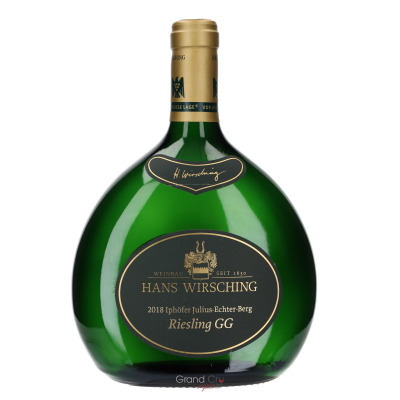
2018 Hans Wirsching Iphöfer Julius-Echter-Berg Riesling Trocken Grosses Gewächs
Wine Profile & Character
The Julius-Echter-Berg rises above Iphofen as one of Franken‘s most storied Grosses Gewächs sites, its slopes cut from the region’s signature Muschelkalk—shell limestone laid down in a Triassic sea some 240 million years ago. This calcareous bedrock, threaded with veins of gypsum and marl, drains quickly yet holds enough moisture to carry vines through the dry, continental summers typical of the Steigerwald’s eastern lee. The vineyard’s south-facing aspect and steep gradient concentrate sunlight and radiant heat, while cool nights descending from the surrounding forest preserve acidity even in a vintage as generous as 2018. Farming here demands restraint: yields are kept low, canopy management is meticulous, and harvest is timed to balance phenolic ripeness against the site’s inherent freshness, a philosophy that respects Franken’s identity as a limestone-driven, structurally serious Riesling region rather than one chasing opulence for its own sake.
In the glass, the wine opens with a bouquet that layers ripe orchard fruit—yellow apple, quince, a whisper of apricot—over a distinctly stony, wet-limestone core, with hints of chamomile, beeswax, and a faint smoky flint that Julius-Echter-Berg often reveals with air. The palate arrives dense and broad-shouldered, a hallmark of the warm 2018 growing season, yet the limestone’s mineral backbone asserts itself quickly, drawing the fruit into a taut, saline-tinged frame. Acidity is ripe rather than piercing, integrated seamlessly into a texture that feels almost creamy at midpalate before tightening toward a chalky, phenolic grip on the back end. Flavors evolve from stone fruit and citrus pith through to a savory, herbal complexity—dried thyme, wet stone, a touch of white pepper—that marks this as a serious, gastronomic expression of the vineyard rather than a simple fruit-forward trocken Riesling.
2018’s warmth produced wines of density and early accessibility, but the Julius-Echter-Berg’s limestone spine ensures this bottling will reward patience. Over the next decade, expect the primary fruit to recede in favor of tertiary notes—lanolin, dried herbs, subtle petrol—while the mineral core sharpens and the texture gains further tension. This is a wine built for the cellar as much as the table, one that will continue to reveal new dimensions well into the 2030s.
Sourced Profile
Compiled from producer and published descriptions, not a firsthand tasting by our team.
Appearance: Deep straw-gold in the glass, with a faint greenish tinge at the rim and pristine, brilliant clarity.
Aromas & Bouquet: Ripe yellow apple, quince, and dried apricot mingle with wet limestone, chamomile, and beeswax. A subtle smoky flint note emerges with aeration, lending the bouquet a serious, mineral-driven edge beneath its orchard-fruit generosity.
Palate & Structure: Full-bodied and dense on entry, with a texture that borders on creamy before the limestone structure tightens things toward the midpalate. Ripe acidity carries flavors of citrus pith, quince paste, and dried thyme, while a chalky, saline minerality threads through every layer. The overall impression is one of power held in check by precise, site-driven structure.
Finish & Longevity: Long and mineral-tinged, closing on notes of wet stone and white pepper with a gentle phenolic grip that lends gravity to the finish. Salinity lingers well after the fruit has faded.
Food Pairings
This wine's density and mineral spine make it a natural match for Franconian classics like Schäufele (roast pork shoulder) with its crisp skin and savory jus. Its saline finish pairs beautifully with river fish such as pike-perch in a beurre blanc, while the phenolic grip stands up to soft, washed-rind cheeses. For a more adventurous pairing, try it alongside roasted quince and duck breast, echoing the wine's own stone-fruit character.
Cellaring & Ageability
Drink 2026–2038, allowing the initial ripeness of the 2018 vintage to settle and the limestone minerality to sharpen with time. Expect the wine to move from fruit-forward generosity toward a more savory, tertiary complexity over the next decade, with peak harmony likely arriving in the early 2030s.